Tuesday, November 20, 2012

Clive Owen Can Intrude Upon Me Any Day


You know what movie doesn’t get nearly as much love as it deserves? 28 Weeks Later. Here was a sequel to one of the decade’s most-loved game-changing horror films, made by a completely different filmmaking team with none of the original cast. It had no excuse for working, and yet in so many ways, it actually bests its predecessor.


It took four years for director Juan Carlos Fresnadillo to make a follow-up, but thankfully, he was kind enough to excuse the long waiting period by casting as his lead one of cinema’s most interesting (okay fine: hottest) actors. 


Clive Owen in a thriller directed by the man who helmed 28 Weeks Later? I. Am. In.

Quick Plot: A little boy in Spain tells his single mother a fairly gruesome bedtime story about a monster named Hollowface, only to then maybe be chased by said mystery man on his rainy fire escape. 


Cut to a middle-class British neighborhood where construction worker Clive Owen (cue drool) dotes upon his 12-year-old daughter Mia, the type of cool kid who becomes obsessed with the very same Hollowface glimpsed at in the prologue. After the sort of near-death experience I assume every construction worker faces on a daily basis, Clive Owen (that’s all he ever needs to be to me) comes home to find Mia in a panic convinced that there’s a monster in her closet.


She is right.

After a few dangerous but non-fatal encounters with a hooded punch-happy giant, Mia and Clive Owen begin to accummulate more suspicion than sympathy. Alongside this story we return to the opening boy and mom who are unsuccessfully seeking aide from the Catholic church and the smarmy soldier from Inglorious Basterds.


Intruders is a very unconventional film that essentially creates its own fairy tale. The story of Hollowface is recognizable to any kid with an imagination, yet the unraveling of the British and Spanish narrative work together in an unexpected way. The film boasts plenty of chilling buildup, but it’s hard to nab just what genre Intruders falls into. It almost calls to mind a more earth-bound Pan’s Labyrinth in how it creates a sort of side universe in the land of the Grimm Brothers. 


It’s hard to go into too much detail without revealing some of the film’s surprises, so I’ll waltz away (and in my head, I’m doing so with Clive Owen) before spoiling anything. Intruders isn’t by any means the scariest film of the year or anything overly groundbreaking, but it’s wonderfully atmospheric and refreshingly new in its approach to what could have been a very lazily told tale. That Fresnadillo needs to keep this up.

Especially if it involves a certain dark-haired hunk.


High Notes
Obviously, Clive Owen is his usual marvelous self but young actress Ella Purnell s also quite good here, proving to be a very intriguing and sympathetic presence in a film that depends an awful lot upon her


There’s a bit of a reveal (not really a twist per say) that makes pretty perfect sense. On one hand, I don’t know why I didn’t see it coming but on the other, I’m hardly annoyed because it’s done so well that it never felt like a gimmick. Strong storytelling all around


Low Notes
Black Book/Black Death's Carice Van Houten is a fantastically interesting actress, making it a shame to see her presence be so wasted here as the shrill wife


Lessons Learned
Clive Owen is a god. I knew that already, but I’m just reminding the rest of you


Other stuff might happen, but Clive Owen is still a god


I’ve learned all I needed to know

Rent/Bury/Buy
Intruders in an excellently fresh film that is unsettling without ever being mean. Due to some aspects of its story, it’s also the kind of film that will most likely benefit from a rewatch. I can also see this as a decent gateway horror movie, the kind that a newbie can watch en route to the hill of Pet Sematary. The movie is currently streaming on Netflix and well worth your 100 minutes. Especially since about 84 of them include this:


Sunday, November 18, 2012

Yummy Yummy Yummy I've Got Fellow Kidnapee In My Tummy


The old 'throw a bunch of strangers in a dark enclosed space and watch bad things ensue' trick has become something of its own subgenre in the horror world. Between random titles like Vile, Die, Shadow Puppets, and the gloriously Clarissa-full Nine Dead, these kinds of 90 minute titles just keep popping up on Instant Watch. 2008's Hunger--not the one with Fassbender's boner--seemed to into that grouping of a post-Saw 2-world, so let's dip ourselves in grime and frowns and hop on in.

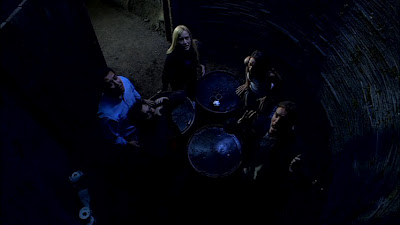
Quick Plot: Five strangers awaken inside a lonely well, where the only articles left are a few tubs of water and a single carving knife. There's also a super neat adjustable video camera controlled by their kidnapper, a well-dressed man who's been keeping notes on his victims and seems to be conducting some sort of experiment: how will a person change when starvation kicks in? 


Of course, these aren't just any people. We've got a nice guy contractor who helped assist in his cancer-stricken wife's suicide. A vacant dancer who killed her abusive boyfriend. The Token Short-Tempered Jerk (there's always one) who was involved in a fatal grocery store robbery. A blond doctor named Jordan whose murderous crime I didn't hear.*** And a twitchy man who has actually NOT killed anyone and who, based on flashes of the unnamed kidnapper's work station, is to serve as the experiment's control.


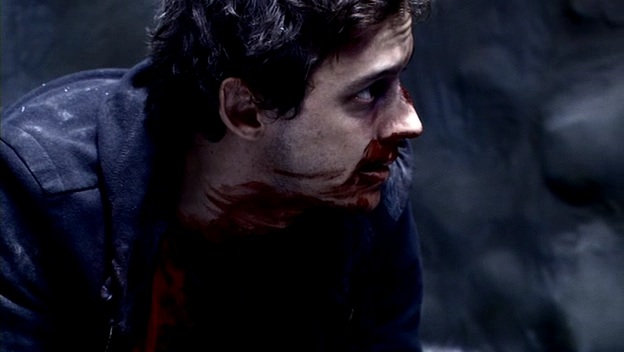
Basically, these five people are left to do nothing but complain about how hungry they are. An attempt at escape ends in effectively executed disappointment. The Control tries to breed cockroaches, something that proves difficult when The Short-Tempered Jerk keeps eating them. Conflict ensues, cannibalism happens, and nobody ever thinks to instead pass the time playing 20 Questions or Never Have I Ever.


Directed by newcomer Steven Hentges, Hunger is a slickly made horror film that definitely sits higher than some of its competition. In terms of its performances and dialogue, the movie doesn't embarrass itself (a la Nine Dead) and scores quite a few effective moments of shock and disgust. Yes, seeing little skin flaps hanging out of our hungry cavedwellers' mouths lends itself to chuckles, but the actors keep the material fairly engaging when covered in blood and human crumbs.


At the same time, just when Hunger is getting good, it decides to also get dull. After 20 or so days in their bricked prison, the survivors fall into specifically combative roles akin to the much more compelling The Divide. The conflict between these characters starts to become quite fascinating, but unfortunately, L.D. Goffigan's script quickly veers away from that line to instead focus on the least interesting character's interaction with a not-defined-at-all villain. 


Speaking of, Bjorn Johnson's silent puppetmaster is easily Hunger's biggest frustration. Though he's given an ickily fun Hannibal Lector-esque backstory, the film never gives the unnamed character the chance to do anything interesting as an adult. He sits at a computer watching the action, frantically zooms in and moves his hidden camera, writes down notes, and alternatively smiles or huffs. What is he hoping to see? The film seems to want him to be a simple 'scientist' (based on his credited character name) but that doesn't necessarily gel with his brutally murderous actions towards a few innocent bystanders. Then again, that entire aside feels like an added scene of standard horror forced into the film to up the running length or provide more action. It's unnecessary, and does no service to an already problematic character.


Have I been getting soft in my old age? As I look back at the recent indie Instant Watch releases I've reviewed here--Asylum's A Haunting In Salem, to name one--I see a pattern developing. I just can't hate a small-scale genre film that does a lot of things right, even when there are plenty of glaring things wrong inside. I didn't have a great time with Hunger, but the film was more than serviceable for most of its running time, throwing in a few surprise tricks while executing itself well. It's a good start, though I doubt I'll remember much about it one year from now. Then again, that IS a sign of old age.


High Notes
With its simple brick wall and bug-trampled ground, the actual well makes an excellent setting. Too often these kinds of 'wake up in an abandoned place' movies rely on unrealistic warehouse or black room settings, but Hunger's claustrophobic setting works quite well in capturing the utter hopelessness of its victims


Low Notes
Considering the dialogue is decent enough, it’s a shame that we can barely hear most of it over the much louder musical score


The less said about the pretty unbelievable feat of strength displayed during the ending the better

Lessons Learned
Just because you’re starving to death is no reason not to have your lip gloss looking good

A broken clavicle is a huge dealbreaker for female doctors


DIY B.F. Skinner wannabes are very thorough about recording their data by computer AND hand

Rent/Bury/Buy
As a 90 minute Instant Watch fix, Hunger is perfectly fine. While it falls into the common post-Saw world of stranger danger claustrophobia, it does tread some new water with the starvation/cannibalism angle, and all is aided by the solid enough cast and a well-designed setting. Many will find it too grimy, derivative, or just plain mediocre. It is these things, but it’s better at being these things than a lot of other Instant Watch offerings. 

My scale of measurement is not high. Now show me some skin.


***The question of what crime Jordan committed was nagging at me, though I chalked it up to 'I have oddly poor hearing for a 30-year-old and/or get distracted by shiny things and might have missed this piece of information.' Thankfully, there's a usually useless resource for movie watchers known as Imdebah Message Boards, and sure enough, in that typical wasteland was a solid explanation for what I thought to be my stupidity: a deleted scene on the DVD reveals Jordan, as a doctor, let a man die on her operating table because he also happened to be her rapist. It makes perfect sense to the character, though why such information would be edited out of the final cut is beyond me, especially considering the young couple murder that seemed to be added simply to pad the running time.


Wednesday, November 14, 2012

I'm Watching You...

And I look GOOOOOOOOOOD


What, the mesh 'n drill look doesn't get your gears grinding? We'll see about that. Come have a listen to The Feminine Critique's second episode, where Christine and I tackle two tales of obsession. First up is William Wyler's incredibly underrated 1965 adaptation of John Fowles haunting novel, The Collector, starring a wonderful Samantha Eggar and an inappropriately dashing Terence Stamp.


We follow it up with Brian DePalma's sleazetastic 1984 Hitchock homage Body Double. You know you're watching a classic when it's got mesh t-shirts AND mullets, and they're not even worn by the same person.


Head to iTunes or refresh your podcast ap (or podcast CRAP, as I like to call it) for a listen, or stream through our Tumblr page. Or do none of these things and know that you're hurting my feelings. 


Sunday, November 11, 2012

So Maybe the NYC MTA Isn't the Worst Institution In the World...


For better and worse, found footage horror has become to the 21st century what the slasher film was to the 1980s and, perhaps more specifically, what the zombie genre has always been to the aw shucks world of DIY indie filmmakers who didn't go to film school. Where enthusiastic wannabe auteurs used to wrangle their friends into undead makeup in the hopes of reaching rental shelves, the generation raised on The Blair Witch Project now uses shaky cam and night vision to make their cinematic dreams a reality. It's just as cheap and, I assume, far less messy.


Strangely enough, I'm also finding it far superior. Like any horror genre, found footage has its piles of duds, but when you compile a list of its offerings, the good far outweigh the bad. For every misguided Diary of the Dead, there's Megan Is Missing, Grave Encounters, and lower profile but still quite strong picks like Skew and The Feed. Even the most successful of the second wave has built itself a solid, if not great franchise in the Paranormal Activity series. 

Thusly do we enter 2011's The Tunnel, an Australian festival hit styled as a combination of Lake Mungo's talking heads documentary and Grave Encounters handheld night vision cinematography. 

Quick Plot: As Sydney faces a water shortage, the city officials propose a new plan that would recycle water currently trapped under the subway's tunnel system. The plan is suspiciously dropped, stirring the interest of go get'em TV journalist Natasha, who rounds up a small crew to head underground and find some answers.


What do they find? Why, a flourishing utopia inhabited by bulldog puppies and trees that grow peanut butter and chocolate of course!


Or an undefinable race of monster men who feed on homeless people and collect their eyeballs. Same difference.

Like the aforementioned Lake Mungo, The Tunnel takes a slightly different approach to the found footage style. From the beginning, we are introduced to our two assumed survivors, Nat and cameraman Steve (the very natural Steve Davis). Their one-on-one interviews are mixed in throughout the film to explain, react to, or preface the 'actual' footage we see from their cameras. Though the effect might take away a little something from a few scenes (it's hard to fear for the screaming Nat when we know she made it to the post-disaster interview), it generally helps to build tension or let it settle in an oddly personal place. Seeing how the unfortunate turn of events affected Nat and Steve is almost as scary as witnessing the horror for ourselves.


The Tunnel had been heavily hyped for me as one of the scariest new horror films of last year. While I wouldn’t put it on the same plain as some of my 2011 favorites like YellowBrickRoad, it does offer some excellent creepiness and more than one moment of genuine fright. The docu-style also helps to add something (somewhat) new, and despite my major gripe of a Low Note, this is one of the good ones.


High Notes
You have to give a hand to any film that sets itself in such a fertile horror location as the deep terrain below a city’s subway system  

As we’ve seen from some of the rougher found footage tales, acting to the camera isn’t always easy. It’s quite a relief that all The Tunnel’s actors deliver natural, but still interesting performances


Low Notes
I'm not sure if it's just the surly feminist in me looking for a fight or if this is a widespread problem in cinema, but ever since Heather Donahue led two pals into the uncharted Maryland wilderness, doesn't it feel like females with power-infused jobs starring in found footage horror are just designed to be responsible for the deaths of others? The Tunnel offers an added layer of icky sexism by having the male characters all insinuate that Nat got--and precariously kept--her position by sleeping with the boss. I don't mind some flawed characters, but there's something about the way the sole female in the film is portrayed and treated that just feels a little unnecessary in its meanness


Lessons Learned
Tunnels carry sound quite well

If you require the services of a 911 operator, you're better off not living in Australia


When it comes to human body parts, eyeballs make the best keepsakes

Rent/Bury/Buy
The Tunnel isn’t quite on the same level as something as weirdly haunting as Lake Mungo, but it’s another example of how a fresh approach at a seemingly played-out subgenre can still work. A sequel has been planned, and if director Carlo Ledesma comes back, I’d be happy to check it out. 

Wednesday, November 7, 2012

Zip It


Watching The Jacket means one has to be comfortable staring into the puppy dog eyes of (and occasionally, up the oddly shaped nostrils of) Adrian Brody. Considering this film was recommended to me by one of my favorite people who also happens to be the unofficial president of the Adrian Brody Stalker Society (or ABSS, as Christine Makepeace of Paracinema/my other half of The Feminine Critique ikes to call it), that all makes sense.


Quick Plot: Jack Starks is a young soldier who rather miraculously survives a gunshot wound to head in the Persian Gulf War. Discharged from the military with some form of amnesia, he wanders down a snowy Vermont road one day and comes upon the young Jackie and her alcoholic mother Jean broken down. Your consummate nice guy, Jack fixes their car before rudely being shoved on by Jean only to hitch a ride with a seedy Brad Renfro, who proceeds to shoot a cop and frame the AGAIN head-shot Jack.


After being declared insane from PTSD, Jack ends up in an asylum headed by Kris Kristofferson's experimental doctor. Every institution for the criminally insane seems to have one, and in this case, the fun starts after hours where Kristofferson and his dutiful orderlies tie Jack in the titular straight jacket and shove him into a morgue drawer. This sensory deprivation is apparently some form of sanity cure.


Or a means to time travel.

During his nightly sessions, Jack experiences an odd sort of freedom. There he is on the street, out of the asylum and free to spend Christmas Eve at the sad little home of a now full-grown Keira Knightley version of Jackie, who smokes and drinks through her raccoon eyeliner as she explains her mother's early cigarette infused death. It's not until Jack starts rummaging through Jackie's knickknacks that he discovers his dogtags, the very same ones he gave to a little girl so many holidays before that the pair realizes the rules of time are being rewritten by Jack’s psychosis.


Maybe.

The Jacket is, very intentionally, a DIFFERENT film, one that defies easy classification. Part thriller and part romance, it seems stubbornly set on being as much of its own thing as it can, something that’s a tad tricky when the influence of the superior (yet still underrated) Jacob’s Ladder cautiously haunts each frame. If you can let go of that comparison, the film is something special, if incredibly far from perfect.


Think of Lost if Lost were set during winter in a drab mental institution. Recognizable character actors stop by to play morally ambiguous supporting roles, including Jennifer Jason Lee as an earnest psychologist and Kelly Lynch as Jackie’s wino mom. The time travel is riveting, even if it doesn’t entirely add up. What’s real and what’s fantasy is left somewhat open, though sadly, Hurley never drives a VW bus, Sawyer never takes off his shirt, and nobody ever asks “Why are you telling me this?”

For reasons unknown, this is becoming a very shirtless review
So really, not like Lost at all.

High Points
Director John Maybury (a former production designer) brings an impressively unique look to the very scope of The Jacket, something wonderfully discussed on one of the DVD’s extra featurettes. The color palette is distinctive, and I imagine one watching JUST for the visuals would have quite a ball


Low Points
Brody grew on me throughout the film and ultimately ends up with a very sympathetic performance, but at the risk of awakening the dragon temper of Ms. Paracinema, does the dude have to deliver each line as if he was afraid of being shushed by a strict librarian?


Lessons Learned
Daniel Craig’s eyes are blue. Like, really, really really, really really really, very quite blue


Without flowers, it’s really difficult to get organized for the rapture

Be careful of the icy patch!


Rent/Bury/Buy
The Jacket is a tough film to recommend since it has such an odd, undefinable tone. The film was somewhat misadvertised as horror (probably accounting for its box office failure) but the feel is more eerie than scary. Still, the story is surprisingly involving and by the end, there’s something bittersweet about Jack’s saga. Like a lot of promising but imperfect films, The Jacket made me more excited to see something else directed by Maybury rather than to actually rewatch this particular film any time soon (especially when one rumored project is Macbeth starring Mean Sean Bean and Goddess Tilda Swinton). There’s an eye behind the camera and some interesting heart to Massy Tadjedin’s script. It just doesn’t quite come together in a fully realized way.