Showing posts with label brian keene. Show all posts

Sunday, November 28, 2010

Nerd Alert! Books Books Books (& Books)


I’m a slacker, but also something of a nerd. Some might even call me a nerdlacker. By ‘some’ I refer to ‘myself.’
See, I read a lot. I write a lot. I combine them sometimes, then forget that I did and end up with today’s post, i.e., a list of genre-esque books I read back in the summer through the fall. That’s my story and this nerdlacker is sticking to it.
Now please let me out of this locker. I have chess team practice and coach doesn’t tolerate tardiness.

The Conquerer Worms
Brian Keene is probably today’s most cinematic horror novelist. Of the three novels that I’ve read, each is drawn so vividly that you can see virtually every drip of blood and scrap of flesh on the page. Taking a break from his successful zombie fiction, The Conquerer Worms is a neat hybrid, part post-apocalyptic narrative and part monster mash.
As the back flap reads, one day, it started raining. And didn’t stop. Lots of bad stuff happened.
Okay, the back flap didn’t say that part. Sometimes I lie.
One half of the novel is narrated by a senior citizen fighting loneliness, desperation, and nicotine withdrawals on a West Virginia mountain as he quietly survives what his neighbors have not, namely, prehistoric worms slowly making their way to devour everything left on the earth’s surface. Eventually, the story switches to a mixed group eking out an existence in a Baltimore high rise hotel, all the while evading merciless Satanists, man-eating mermaids, and gigantic carnivorous sea creatures.
I’ve yet to be disappointed by Brian Keene’s writing. Though it starts a little slower than some of his other zombie fiction, The Conquerer Worms is a gripping tale that keeps you in constant suspense. Keene’s ability to use unique narrative voices is in full force, with Teddy Garnett’s wise old man making the reader easily emotionally involved. The second story lacks the same heart to put you on board with the characters, but it makes up for it with brutal storytelling that gets darker with each page. An easy recommendation.

The Bridge
Penned by ‘90s splatterpunk heroes Craig Skipp and John Spector, The Bridge tells the story of a Pennsylvania town on the edge of a pollution caused Armageddon. Gooey mutations ensue.
Though it suffers a little from trying to cover too many characters, The Bridge remains a fun summer page turner rich in gruesome carnage and icky monster imagery. It doesn’t read like poetry, but for a horror movie in your hands, it’s an enjoyable way to pass some time. 

The Exorcist
I’m a fairly easy person to make happy, but to really bring me to a state of bliss, throw a pile of slightly used books on the sidewalk with a sign that says ‘Free.” That’s how I picked up my paperback, coverless copy of William Peter Blatty’s infamous 1971 novel,  the very piece that spawned a somewhat popular movie with a killer third installment, The Exorcist.
To give a disclaimer, of course I’ve seen The Exorcist but sadly, it was at the wrong time in my life. I grew up with horror so it didn’t seem inappropriate to rent the VHS in fourth grade. Unfortunately, it was probably the worst possible age. At 10, I was too young to get some of the sexuality and despite a minor Catholic education, not quite old enough to fully grasp the religious aspects involved. Meanwhile, my soiled elementary school eyes had already witnessed their share of zombie mayhem and slasher guttings, rendering some of the violence tame by my then-standards. I’d seen Karen Cooper get zombified then slaughter her mother with a garden spade, both in color and black and white. Why should I care about one rich girl fighting a demon who didn’t have anything better to do? 
There are two main observations I made in comparing Blatty’s novel to Friedken’s Oscar nominated film (you know, the one that according to Kristen Stewart’s Oscar writers, was the last horror film to come near winning a little gold man except...stop it, nerdlacker). The first is just how closely the script follows its source, straight down to the infamous spider walk and crucifix masturbation. On the other side is how much more psychologically based the novel feels, as more pages are devoted to a faith vs. reason debate than gore. It makes perfect sense that Blatty would later go on to direct The Exorcist III, a film filled with powerful imagery, engaging dialogue, and open questions about the nature of evil.
But as much as I would kind of love to always talk about The Exorcist III, I think the title of this post is supposed to be devoted to books. So read the book, then see The Exorcist III.
Community service, you’ve been served!

Cover
Many of you already know of my love and admiration for the fictional horrors of one Jack Ketchum. Between his gruesome novels and deeply chilling short stories, he is, without doubt, my favorite genre writer.
Cover tells the tale of Lee Moravin, a Vietnam vet whose psychological war scars are so deep that he simply can’t live with others. Left alone in the woods with a loyal dog (seriously, no one writes man’s relationship with his pets quite like Ketchum) and a thriving marijuana farm, Lee rotates between woodsy solitude and violent flashbacks. 
Meanwhile, a group of middle aged literary yuppies (plus a surprisingly well-drawn supermodel) take an innocent wilderness weekend trip just outside Lee’s territory. In no time, Lee declares the city slickers his Nam enemies and plots a vicious hunting spree. 
Cover is not my favorite Ketchum read, but it’s brisk and fairly addictive. Lee is a fascinatingly tragic figure, a sympathetic man who’s seen some of the worst sights imaginable. In another plot, he could be a hero, yet once our ‘civilized’ campers enter his borders, he’s a bloodthirsty killer we can’t possibly root for. The balance Ketchum achieves in drawing both sides as real people dropped into the wrong situation is horrifying and believable. In no way is this the most fun you’ll have with a book, but for darker days, it’s a high recommend.
On the Beach
I’m not exactly sure why I find so much enjoyment in reading depressing sagas about the end of the world, but let’s just look past the psychology to discuss 1957’s On the Beach, a twice-filmed novel set just after a worldwide skirmish has brought upon Armageddon. Nuclear fallout has left a rash of radiation in the air and as surely as the wind blows, every drop of human life will eventually--months, weeks, days--be killed.
Set in Australia (one of the last reaches to receive the pollution), On the Beach focuses on a few key characters trying to make the most of their final days. An American naval officer continues to live as if his family is alive, even though nobody has heard a breath of life from US soil in months. If he could face the truth, he’d surely fall for the twentysomething unmarried (and doomed to die alone) local girl who struggles to find anything worth living for when there’s nothing that can be started and completed in the time remaining. A young couple raises their newborn without consequence until factors call for the dreaded suicide pill discussion. There are deadly auto races that let the brave go out in a flame of glory. Some people prefer to drink themselves to death.
Depressing, sure, but also fascinating and told with intelligent restraint. Author Nevil Shute was predominantly known for military literature and though some of that does show up on the more naval-based pages, On the Beach is much more about character and humanity than submarines. Though a few officers discuss responsibility and world politics, the novel focuses far more on the individual reactions to what war has left. The result is a haunting tale I couldn’t put down.

Sunday, September 6, 2009

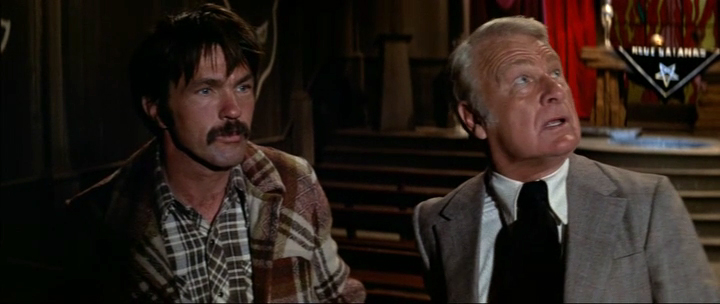
Someone Left the Satanists In the Devil's Rain


Having just started reading Brian Keene’s The Conqueror Worms, I enthusiastically queued up this month’s Final Girl Film Club pick, The Devil’s Rain, fresh in the mood for some truly terrifying precipitation.


Okay, who am I kidding? With Ernest Borgnine headlining the movie poster wearing a satanic priest’s robe and ram horns, plus the promise of a doughily shirtless, sideburn styling, prominent belt buckle wearing William Shatner, I knew exactly what I was in for. This 1974 Robert Fuest helmed horror emits a powerfully pungent odor of deliciously aged cheese from the opening credits to the gooey end. Know your limit for lactose tolerance before indulgence.


Quick Plot (if that’s what you can call it): A promisingly haunting credit sequence features creepy medievalish hell paintings, guttural moans, a set of disembodied ears holding a butcher knife, and one of the oddest listings I’ve ever seen: Technical Advisor: Anton Szandor Lavey, High Priest of the Church of Satan. I don’t know what technicalities Lavey advised on, but you Satanists should not be proud. No offense to Satanists; it’s just a really bad film.


Next, we jump into a dark and stormy night where Shatner awaits the return of his soon-to-be-melted father bearing a message to return the book to Corbus. If that makes no sense to you who haven’t seen the film, it makes about 3% more to me, and I watched the whole thing. Then again, I also missed John Travolta’s two second film debut as a waxy faced Satanist, so maybe I’m just not nearly as intelligent as Fuest’s intended audience.


Shat adjusts his cowboy hat and bravely heads into a ghost town in search of his vanished mother and to battle John Corbus (Ernest Borgnine...we’ll get to him) for the return of her soul (I think). Corbus has his sights set on a missing book once stolen by Shat’s ancestors. They have a showdown inside the “New England”-ish church (which, according to one character, does not belong in a western desert), which is actually a Satanic holy place (you can tell by the stained glass artwork straight off a metal band’s drumset). By showdown, I mean Shatner prays and shoots a few worshippers while Borgnine speaks Latin and smiles smugly.


Enter Tom Skerrit as Shat’s brother, a young doctor with a fabulous mustache and a conveniently semi-psychic wife who helps explain the history of our characters with a dreadfully lit flashback. Believe me, you haven’t seen American history until you etch into memory the image of Borgnine in full Pilgrim getup, shooting out lines like “Didst one of thee fall from the favor of Lucifer?” to what I imagine to be a group of escaped community theater actors in a dress rehearsal for The Crucible. It’s more wonderful than it sounds.


After being separated from his wife, Skerrit enlists the aid of his superhelpful mentor, Dr. Sam Richards, a parapsychologist who actually took ten minutes to read the sought after book and therefore has some semblance of what might be going on. Together they discover the world’s coolest faberge egg, complete with a television screen that displays all the lost souls trapped in hell. It also contains the titular devil’s rain, a force so powerful, it can melt any eyeless minion into a gooey pile, not unlike the result you get if you’ve ever tried to light one of those Spencer Gift Store’s novelty candles of glittery waxen wizards.


If it seems like I’m hopping through plot points like Leprechaun on a pogo stick, I do apologize, but The Devil’s Rain is simply not an easy film to summarize. It’s also not the easiest film to watch, as its grainy, dull lit action actually aggravates the eyes at times. There’s nothing frightening, clever, or particularly interesting about this satanic romp, but that’s certainly not to say The Devil’s Rain isn’t amusing.


High Points
Borgnine is kind of amazing as Corbus, and by that I mean he’s hammier than an out-of-work Miss Piggy at a French buffet


The melting effects are fairly impressive when watched on a small screen. This is vital as they take up a way too extended sequence that seems to run longer than the entire film


Low Points
Odd that the scant 86 minute run time contains such prolonged scenes as the Satanists’ desert march (which clocks in at 3 minutes) when a few quick bites of exposition could certainly have padded out the length while, you know, explaining stuff


While I didn’t exactly hunger for more Shatner (I may be a woman, but I am fairly immune to his muggy charm), the switch of protagonists at the halfway mark was a little jarring. It wasn’t that Tom Skerrit was awful or even that Shat was any good; as an audience, however, we have little to hold onto when we don’t know a thing about who we’re supposed to be rooting for


Lessons Learned
When he visits earth, Satan generally resembles any animal character played by a human on Shelly Duvall's Faery Tale Theatre


When you hear your mother screaming, it’s best to stare worriedly at the source of the sound before slowly jogging to see what the trouble is


Satanists bleed sour milk and have elegant penmanship


If when driving, an eyeless zombie creature pops up in your backseat, avoid removing both hands from the wheel to grab your hair as you scream. Sure, you may be frightened at the uninvited hitchhiker about to kill you, but that’s how accidents are caused


Winning Line
“Remember: no one knows what we’re about,” Corbus growls to his colonist clan, only to then open the door to an angry mob carrying torches and Salemnesque judgement


Rent/Bury/Buy
The Devil’s Rain is a pretty horrid film, but if conventionally horrid sounds like heaven to you, then by all means, rent it and crack open a bottle of some bitter water (because it’s so sweet). There seems to be two DVDs on the market, and unfortunately Netflix sends out the bare bones 2000 release, with mere a trailer, stills gallery, and a nice screen shot of John Travolta’s big closeup, complete with the signature chin cleft. If John Waters can record a commentary for Mommie Dearest, then surely someone with a touch of wit could put a nice audio spin on The Devil’s Rain. If nothing else, hire a grammar expert to pick apart everything from the tagling--Heaven Help Us All When The Devil’s Rain!--to Satan describing himself as “the highest, most exalted king” because a) is he not the only king? b) not the first king? and c) is there another king that was merely exalted?


Don’t forget to head over to Final Girl’s site for a roundup of other horror bloggists reviewing Borgnine’s satanic adventures. This is certainly a pick ripe for riffing, so be sure to read everyone’s reviews, then balance out your dairy intake with a hearty round exercise.


Or just by watching a better movie. Your choice.

Sunday, March 1, 2009

NERD ALERT! Brian Keene's Dead Sea


I’m generally underwhelmed by horror fiction because in my experience, it's too often riddled with clunky language and character cliches. Every now and then, however, I brave the library in search of a good gore-filled read to make the subways more interesting and long lines less infuriating.


Brian Keene, author of the well-known zombie epic The Rising, is quickly establishing himself as a major figure in the undead world of corpse-munching bookworms. Dead Sea was published in 2007, and packaged in a conveniently petite package, it’s pure comfort food. If World War Z is a five star meal at an unpronounceable Zagat rated restaurant with three forks and cloth napkins, Dead Sea is a greasy burger oozing in cheddar cheese and served with salty fries.


The novel begins in the projects of Baltimore (complete with a much-appreciated-by-me shout-out to The Wire), where our narrator, Lamar Reed, is struggling to cope with the city-wide infection of Hamelin’s Revenge (as the plague is commonly called due to its origin from rats). Zombies are rampant, in both human and various animal forms. As Baltimore stars to burn, Lamar is forced on the move and quickly befriends two spunky kids and an incredibly useful gun enthusiast/ex-Bible salesman. After a series of undead swarms (one of which includes a tiger), the group boards a retired Coast Guard ship with a motley crew of diverse survivors.


Dead Sea has quite a lot to offer zombie fans. Keene spares no grisly detail as he describes the walking dead so well, you can almost smell the stench of rotting flesh. The concept of Hamelin’s Revenge “jumping species” is truly terrifying and opens up a whole new realm of horror possibilities rarely explored by other works. Any zombie fan living in a coastal area probably assumes that in the event of disaster, the ocean is the safest place. Sure. Because zombies don’t swim. But zombie humans walk. And logic would follow, a zombie fish...well, I’ll avoid spoilers and just tell you to buy the book.


One of the most refreshing aspects of Dead Sea is Keene’s prose. As our narrator, Lamar has a strong and unique character voice, aided by the fact that he’s gay and black in a genre that rarely acknowledges a man like his existence. There are no token romances or overly villainous stock characters, and while Keene does get a little too obvious in dressing up his heroes with blatant discussions on archetypes and Joseph Campbell references, the novel ultimately succeeds in creating people to care about in a world ready to devour them.