Showing posts with label alien. Show all posts

Monday, September 4, 2023

In the Sea, No One Can Hear You Scream


The best way to force my hand in watching a movie? Threaten to remove it from streaming! Hence today's feature, which had sat on my Hulu queue for an eternity before falling into the "expiring soon" death list. What better time to dive in? (and yes, considering the aquatic nature of Sea Fever, that pun was intentional.)

Quick Plot: Siobhan is great with research and anomalies but bad with talking to people, making her graduate school program slightly more complicated than she'd like. She reluctantly departs on the Niamh Cinn Óir fishing vessel for some fieldwork, where the tight knit crew immediately bristles at her ominous red hair.


Still, a job's a job, and Captain Freya and husband/skipper Gerard plow on, only for the boat to run afoul of some kind of squid-like creature deep in the "excluded zone". Siobhan is justifiably freaked out, but Gerard smells a big payoff. A messy fishing attempt leads to crew member Jack being injured and the boat's winch breaking, but hey! There's a boat nearby!


And naturally, said boat has its own problems: a busted radio and dead crew, some with their eyeballs gouged out. By the time young Jack is burning with his own fever and ocular woes, it's pretty clear to Siobhan that there's a parasite aboard the boat...and most likely, several of its members' bodies.


Written and directed by Neasa Hardiman, Sea Fever wears its Alien and The Thing-references all over its wetsuit sleeve, and I have no problem with that. Though it has some recognizable faces (Dougray Scott and Connie Nielsen play Gerard and Freya) Sea Fever is clearly a fairly bare bones production, set almost entirely on the claustrophobic boat. It gives us just enough fairly natural conversations between crew members for us to draw a clear enough picture of who has what at stake, so it's easy to care about their fates without exposition overload. Likewise, Siobhan's awkward data-driven nature is perfectly established and gives us a clear compass as the facts unfold, especially as the film dips into just-ahead-of-its-time morality on quarantine responsibility.


There's something extremely efficient about Sea Fever. Its barely 90-minute length wastes no time, but for the most part, we still get everything we need out of the characters and story. Plus, a giant squid! Okay, we don't get MUCH of the squid (if that's what it actually is) but a jellyfish-y sea monster that eventually causes eye explosions? That's pretty darn neat. 

High Points
Without spoiling anything, I was quite satisfied with Sea Fever's ending, which feels appropriate to the story's nature and emotionally right for the characters


Low Points
With so few characters, I would have liked just a little more time to better understand the one with the foggiest fate (Texas Chainsaw Massacre's Olwen Fouere)

Lessons Learned
Fishermen don't swim because they'd rather die fast


College bars are the ideal location to further investigate the possibilities of UV rays

Crazy idea, I know, but hear me out: if you discover a gooey glowing substance eating away at many layers of metal, perhaps the best course of action is not to touch it


Rent/Bury/Buy
I don't know which streamer Sea Fever moved to, but hop onboard if you can. This isn't the find of the year by any measure, but it's solidly made and incredibly clear-headed about the story it wants to tell. Bon voyage.

Wednesday, July 13, 2011

NERD ALERT! Shock Value


If you're even a ticket stub-size as movie nerdy as I am, then you're most likely always on the lookout for a good physical BOOK (remember those?) about genre film. There are the personal library shelf standards--Carol Clover’s Men Women & Chainsaws, Kim Newman's Nightmare Movies or the Joe Bob Briggs canon, to name a few--along with less impressive works, generally those that aim for unworthy self-importance or offer nothing more than tidbits gleamed from a director commentary track.
TLC Book Tours sent me, and many of my favorite fellow film bloggers Jason Zinoman’s new book, Shock Value, now available from Penguin Press. Focusing on a handful of auteurs who helped shape horror as we know it today, Zinoman explores how American horror of the late 1960s and 1970s evolved past its playful, mostly innocent roots into something realer, bleaker, and deeper.
Wes Craven, John Carpenter, Dan O'Bannon, George Romero, Roman Polanski, William Friedken and Brian De Palma get the most attention as Zinoman’s writing shapes just how they came to make their flagship films. Yes, some of the anecdotes have been heard before in interviews and DVD extras, but Zinoman lays it out in a manner that's both comprehensive and interesting, lending insight into how everything from Craven’s strained relationship with his Christian mother to Hooper’s experience documenting a shooting victim’s death in an ER led to such creations as Last House On the Left and The Texas Chainsaw Massacre.

Virtually every horror fan with a DVD player knows about William Shatner's connection to Michael Meyers, but most have never learned the decades-long saga of John Carpenter’s frenemy-like relationship with his one-time collaborator and pal, the late Dan O’Bannon. O’Bannon, the superbrain behind Alien and creator of Return of the Living Dead, might very well be one of horror and science fiction’s most important figures of all time, yet it’s rare that the writer/director gets his due. Unlike most of the other directors on profile, Zinoman follows a large chunk of O’Bannon’s career, including everything from his work on Dark Star to how his Crohn’s disease birthed (pun sorta intended) one of cinema’s scariest scenes of all time. It’s refreshing to get a fair and multi-faceted portrait of a criminally underrated talent, even if it means making Carpenter, long-time hero of genre fans, come off as, well, a bit of a jerk.

For the other filmmakers, Zinoman narrows his focus to their earlier work, using the common misconception of Hitchock’s grandfatherly status in the new wave of horror as a starting point. "As influential as he was, the notion that Hitchcock is the inventor of the modern horror genre is overstated," Zinoman claims, citing the explanatory nature of Psycho’s coda as the exact opposite of what the Shock Value subjects did with their own nihilistic spins. The Exorcist is commonly referenced as the key representative of this brand of horror, but I’d never quite heard how Friedken’s interest in the work of minimalist playwright Harold Pinter lent so much to general structure and ambiguity of the film (something author William Blatty fought against and lost until the special edition released 20 years later). 

Some territory has been well-tread, including a few morally dubious tricks Polanski used on Mia Farrow during Rosemary’s Baby and how Gunnar Hanson was so miserable while playing Leatherface that he actually found himself wanting to hurt Marilyn Burns’ Sally. What Zinoman does well with some commonly-known facts is put them in context. To explain the evolution of how Rosemary’s Baby went from a gimmick-ready William Castle film to the Oscar winning classic it became while following it up with an examination of Peter Bogdanovich’s controversial yet rarely discussed Boris Karloff vehicle Targets helps to create a dynamic timeline of the new horror cinema.


A writer for the New York Times, Jason Zinoman clearly knows and cares for genre films, and it’s refreshing to hear a balanced but passionate voice on the subject. Though  his closing chapters feel a tad too dismissive of modern horror, Zinoman does make a strong case for just why these titans of blood and guts will probably never quite be matched. It’s not that their films are perfect (in fact, even the author seems to objectively point out one issue or another with virtually all of the touchstones on display here) but the mere combination of U.S. culture and the newfound independent market simply gave way to a type of filmmaking that tapped into something deeper than ever before or, so far, since. “These are movies that want to confuse you, in part because getting lost focuses the attention on the terror of uncertainty,” writes Zinoman. “They endure, like great art does.”

Shock Value isn’t the end-all for genre studies, but those on the lookout for a good read on the subject will most certainly find some new nuggets worthy of exploration. While there's plenty of ground around and within the films that could still use some attention, the book provides an interesting thesis on the development of modern horror while also offering a few new perspectives on classic and underlooked films.  It may also give you plenty to argue with, so pack some post-its in your beach bag and enjoy some summer reading the right way.


Friday, April 23, 2010

Space: The Jan Brady of Earth Day


Oh Earth Day huh? Guess what-I LIVE on the earth. Every day.

What about Mars? Jupiter? Naboo? Or those shiny high-tech ships floating in between? 

In honor of all those masses of matter not acknowledged by 24 hours in spring, I give you a few choice options for genre films not bound to the third planet from the...


Sunshine


Danny Boyle’s true masterpiece, a polarizing mashup of 2001 and Halloween, is a visual vacation that poses rich questions about science, faith, morality, and just how powerful a fantastic musical score can be. Straight sci-fi fans typically rip on the Event Horizon-ish final act, but it’s a natural extension of the sun-as-false-god themes that begin the opening scene. Then again, since the main plot surrounds saving a certain water-based planet, perhaps this film doesn’t belong on the list at all.

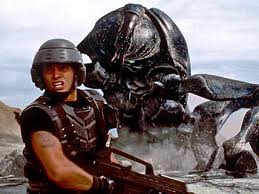
Starship Troopers


There aren't really enough words in the English language that properly express the joy that can be found in Paul Verhoeven's original 1997 satirical sci-fi thriller, so it's fitting that most of the film takes place in another galaxy (where I'm sure another mother tongue can add to the vocabulary). Based on this series (originally envisioned by controversial-lite Robert Heinlein) of great gore, 90210esque romance, and cutting satire, Earth may be a far prettier planet than what’s found in the outer ring, but it’s also filled with fascism, genocidal militarism, and Denise Richards. I’ll take the bug planet.

Jason X


Fans of the franchise are deeply divided over the tenth outing of Mr. Voorhess, set 450 years in the future and filmed on the cheap in Canada (not quite as exotic as space, but with better pancakes). Personally, I can't get enough of a face-dunk into liquid nitrogen, a David Cronenberg cameo, tight-in-all-the-wrong-places space uniforms (for the ladies only, natch) and the general spirit of low rent cheese dripping off every bargain priced reel. 

Alien(s)


The grandfather (well, more appropriately, grandmother) of modern sci-fi horror, the first two films from this franchise make a fine case for moving off-planet, if only to experience better movies.

Event Horizon


This surprisingly atmospheric debut of Paul “Not Thomas” Anderson, Event Horizon mixed the cold space castaway mood of Alien with a good old fashioned Nightmare on Elm Street dreamy slasher batter. Infamously edited by a baffled studio, Event Horizon has survived twelve years as a mini-fan favorite, a bloody sci-fi that plays with wormholes, hell, and gravity. Memorable moments include Jack Noseworthy’s nose worthy nosebleed and glimpses of carnal orgies not quite touched upon in Apollo 13. Ever wonder why you didn’t get that Oscar, Ron Howard?

Moon


Much like Sunshine, Duncan Bowie’s 2009 film doesn’t really have a home base in any strict genre. As a scientific premise mixed with horrific possibilities and striking moral drama, Moon tells the tale of an astronaut (played insanely well by Sam Rockwell) living alone 239,592 miles from earth (who needs it). To say more borders on immediate spoiler territory, but for lunar cinema that disturbs on an intelligent (and very human) level, head to the Moon

Leprechaun 4: In Space


Somewhat inevitable and sadly disappointing, this fourth entry into the Leprechaun saga never quite finds its inner chest burster. Still, you can’t go totally wrong with the spirit of Warwick Davis being transferred through urine and er, other bodily fluids, especially when light sabers are involved.