Sunday, January 13, 2013

Math Class Redux!


A scalene triangle is one in which all three sides (and therefore, angles) are not the same. Since Scalene is not a movie about triangles, you should keep this in mind.


Quick Plot: We open on some sudden violence as a middle aged woman named Janice Trimble barrels her way into an upper middle class suburban home in a clumsy attempt to gun down a pretty young woman named Paige. Awkward girl fight commence!


We quickly cut to a chronologically earlier scene as Janice purchases her gun, and next, to one where we see why: her mentally impaired son Jakob has been sent to a mental hospital after allegedly attacking Paige, his home aide. Along with these scenes comes some heartbreaking moments as Janice tries to raise the silent Jakob while attempting to start a sweet romance with a bearded nice guy. As the scenes flash backward Memento style, we see that the sad roots of this family's plight. It's heartbreaking.


Or is it heartbreaking for other reasons? After we flow through Janice's past, we're switched to the more surreal point of view of Jakob, who sees the world from shaky, even LESS linear eyes. We only linger there a little while before switching to the (maybe) more straightforward perception of Paige, a sociology major with good intentions who begins to suspect something amiss at the Trimble house. Is she right, and have we been tricked by Janice's point of view? Or is Paige damaged in her own twisted style in a way that, due to her position, nobody (including the audience) will ever have any reason not to trust her instincts and actions? 


Scalene is a difficult film, something I say as a compliment. Much like the even darker Red White & Blue, Scalene is film that challenges its audience and refuses to let them know if they've won. Grounding it all are three fantastic performances in roles that require an awful lot from their actors. Margo Martindale is one of those faces that you've seen in bit parts forever before she finally gained some mainstream fame with an Emmy award for Justified. She's the kind of 'real woman' actress who you always want more of, someone who can steal a scene from Dexter's Michael C. Hall while laying in a hospital bed bemoaning the lack in quality of key lime pie. As Janice, Martindale gets an incredible chance not just as the long-deserved lead, but as a character who acts from three distinctive point of views. It's juicy, and she squeezes it for all its worth.


Equally good is Hannah Hall (young Jenny in Forrest Gump!) in the tricky part of Paige. While it's easy to side against her, Hall plays Paige with an intriguing balance of entitlement and good intentions. As Jakob, Stake Land’s Adam Scarimbolo has to play a brain-damaged young man with little glamour. It works.


Directed by Zach Parker (who co-wrote the script with Brandon Owens), Scalene is bound to be a divisive film. The backwards approach might seem to some to be derivative of Memento, though I found it an effective way to immediately catch you off guard, forcing you to see the sad effects of some choices and putting your pity in a certain place, only to later twist that around with another point of view. Ultimately, the fact that the narratives don’t *quite* add up makes Scalene something deliberately uneasy, a film less about who’s right than who’s who.


High Notes
It’s called ACTING!


Low Notes
The opening scene features an appropriately awkward, even humorous fight scene. While it's an entertaining and ultimately fitting way to start the film, the choice in score--which goes from Hitchcockian suspense to near-circus cues in less than 3 minutes--almost calls too much attention to itself. I think I understand what Parker is trying to do in terms of toying with tone, but upon first viewing, I just found it distracting

Lessons Learned
When it comes to college, blonds only hang out with blonds


Always check the flipbook before ordering pizza

In some states, it’s REAL easy to buy a gun


Rent/Bury/Buy
I hesitate to heartily recommend Scalene, as it's sure to polarize a large chunk of any viewing audience. While virtually everyone will appreciate its key performances, the very nature of its ambiguity is bound to make some viewers flat-out angry. I for one thought Zach Parker's approach was both unique and incredibly powerful, especially when aided by the powerhouse that is Margo Martindale. The pieces don't add up, and while that might indeed be frustrating, it also makes its own point. Scalene is currently streaming on Netflix and makes me an uncomfortable, but fascinating view. Word on the Internet Superhighway says that the DVD includes a few special features, and considering this is a movie that will easily benefit from a rewatch, I just might put it on my shopping list.

Friday, January 11, 2013

Ear This!

It's a double whammy of podcast punching this week. First up, my 7-episode old show, The Feminine Critique, Christine and I don our glittery synchronized swimming caps and head to the water.


Literally...

And figuratively.


Download us with your podcast ap thingamajig or head here to stream.

Also in podcastland, I guest star on this week's episode of Outside the Cinema, where host Bill By Force and I discuss Mario Bava's pre-giallo giallo The Girl Who Knew Too Much and, far more excitingly, the Mario Lopez star vehicle form 1999, Outta Time.


I don't know how else to say it: Outta Time is the greatest 90 minutes you never knew existed.

Head here  for the full experience. Hurry up! Dive in!


Tuesday, January 8, 2013

We're Gonna Need a Bigger Pair of Glasses


You know what's awesome? Sharks. You know what some moviegoers seem to think is really awesome? Paying $5 extra to wear glasses during a movie. 


Nerds.

Jaws 3D is about sharks (which is awesome) and was heavily touted as showing them in 3D (which some people think is awesome). 

Let us evaluate now.

Quick Plot: Mike Brody (Dennis Quaid), New England's favorite sheriff's eldest, works at SeaWorld with his biologist girlfriend Kathryn (played by My So-Called Life mom Bess Armstrong with intelligent pluck). Younger water-phobe bro Sean comes to visit/flirt with Lea Thompson's water skiing princess right about the same time a Great White sneaks his way into the theme park, much to the denial of Louis Gossett Jr.'s priority jumbled boss.


Directed by Jaws (and its first sequel)'s production designer Joe Alves, Jaws 3(D) is fairly infamous for its use and abuse of 3D, that oft-loved gimmick that was making its first big comeback in the early '80s. With a screenplay that had clearly seen its share of white-out and second drafts (including one that was penned by Richard Matheson), Jaws 3(D) was never going to be a boat-rocking classic like its original. Watching it 29 years after its fairly ill-fated premiere, the real question I had was if it fell into the sequel camp of 2's okay-ish blandness or 4's hilarious badness.


Not surprisingly, Jaws 3(D) falls somewhere in between. The cast, as you've probably realized, is loaded with before-they-were-semi-famous stars and all of them know how to sell a mediocre scene, even when the writing is duller than a Fisher Price knife. There's even some successful character-based humor in Sean's water fears and plenty of warmth in Kathryn's relationship with SeaWorld's stars of the '80s, Sandy & Cindy and--get THIS--SHAMOO!


At the same time, we're treated to about twenty three conversations between Kathryn and Mike where they worry about their future, since he's been offered a job in South America and she has six months left on her contract plus an opportunity to--


What, am I boring you? How do you think I felt? I'm the one who had to sit through that conversation. 90,000 times.

See, Jaws 3(D), like many a big budget summer blockbuster hopeful, is hampered by a lazy and probably very rushed screenplay. It's great to have a respectable romance at your center, but when every scene with your leads ends with a pro and con list about their career plans, you can't really expect the popcorn crowd to swoon.

That of course leaves the thrill of Jaws 3(D) in the busy hands of its technology, which next to the dolphins and Shamoo, is easily the most adorable aspect of the film. In the first of VERY FEW shark attacks, Jaws 3(D) almost fools you into thinking you're getting some actual suspense and scares, only to reward high ticket price payers with a gleefully hilarious in yo' FACE shot of a severed arm, menacingly floating towards your imaged red and black lenses. Other 3D shots include a syringe squirting at you, a statue that's, well, a statue, a head (yes, it belongs to the same torso as the aforementioned arm only it gets to surprise a gaggle of happy tourists) and a POV shot from inside the shark's throat. That one's more weird than cute, but I give the film credit for trying.


The most fascinating aspect of Jaws 3(D) comes from its apparent corporate sponsorship. SeaWorld was clearly heavily involved in the filming, supplying some mammal co-stars and its name brand. But consider this: the main plot of Jaws 3(D) hinges on the fact that a 35' long Great White is loose inside a theme park, the kind of theme park families pay hundreds of dollars to tour on vacation. What this means is that SeaWorld has incredibly questionable construction and safety. 


Which means SeaWorld put its name and face (and dolphins' faces) on a movie that might very well be the most damning ad campaign imaginable. The equivalent would be something like Roller Coaster taking place at Great Adventure or WestWorld being recast with Mickey Mouse in the Yul Brynner role. 


I know: I want that movie too.

High Points
Kudos to any blockbuster for including a smart, brave, and quick-thinking career-minded woman as its heroine


Low Points
The final body count, SPOILER ALERT, is an all-mighty but unlucky-in-Asia 4. Four. Quatro. FOUR. This displeases me, especially when you keep setting up mob scenes in the water as a 35 FOOT LONG SHARK SWIMS BY ON AN EMPTY STOMACH


Lessons Learned
Beware the fat man in the bumper boat


Dolphins are way smarter than mere humans, even PHDs with veterinary degrees


If you love someone, you will never, ever never, take them on vacation to SeaWorld


Stray Observatiuon
Bella Swan, eat my Neosporin! In terms of who the clumsiest character in cinema history might be, I'm giving the edge to the hilariously bull-in-china-shop-that-is-a-beach Mike Brody. The man almost makes me look graceful, and I once slipped on a banana peel and cut my finger on sour cream 


Rent/Bury/Buy
Well, Jaws 3(D) isn't actually close to being good, but it's enjoyable in a super '80s way that certainly has its charms. Think of it as a nice summer popsicle when you're not really hungry, but require mild nourishment.  

Saturday, January 5, 2013

Somewhere Beyond the Grave, Dull Stuff Happens


Zombies! Apocalypse! Samurai swords! Magical ear-bleeding harmonicas!


Damn you raised expectations.

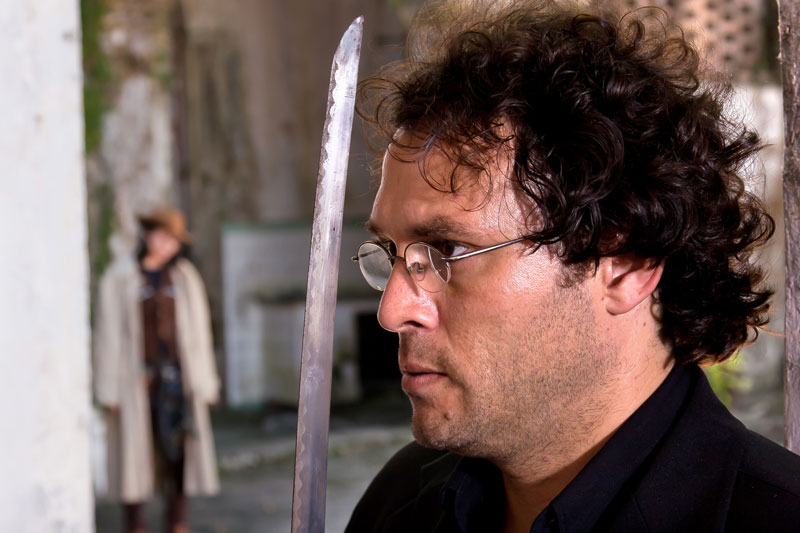
Quick Plot: In ‘another time, another place’ (presumably in the future), a dark clad man (known only as The Officer) wanders the post-apocalyptic landscape in search of The Dark Rider, a mysterious, maybe supernatural killer terrorizing what’s left of humanity. The radio bids whoever is still out there to have a nice day, with little optimism that anyone is listening to say thank you. Also in the mix is a trio of bizarro harmonica playing murderers and a small population of the walking dead.


I guess they eat human flesh? It’s never explained, which is actually quite neat. For the first half hour or so of its running time, Beyond the Grave offered something truly refreshing: a different kind of apocalypse. Filmed in Brazil by newcomer Davi de Oliveira Pinheiro, it mixes standard zombies with a sort of free-range magic element set against a rather beautiful (and rarely seen on film) landscape. 


Boy did I want to like this movie.

Much like the Civil War zombie opus Exit Humanity, Beyond the Grave is an ambitious piece of work that combines recognizable horror tropes with a different kind of storytelling. The Officer is a stoic hero (I guess) who gradually amasses fellow survivors, all equally defensive, quiet, and hard to care about.


At a certain point, I realized Beyond the Grave was a story of a man of no words entering dark buildings to investigate weird occult signs while he tells a young teenage couple to wait in a car until something comes up, at which point one of of them runs into said dark building to retrieve said man of no words and they move on.


This happens twice.

Thankfully, we get a minor reprieve when we meet a few more dynamic characters holing up in an old school building. Like everyone else in this movie, we never have any idea how they are related to one another, but at least the man in charge smiles.


In this movie, that’s a feat.

I respect Beyond the Grave quite a bit. It goes for something new and doesn’t back away from doing so without mercy. Unfortunately, it also finds a way to bleed every minute in such a way that makes the experience feel endless. At about the halfway mark, something huge happens that seems to redirect the entire story. It’s fairly awesome in theory, except that a) the movie doesn’t fully follow through with it in any way that seems to make sense and b) there’s still half of a dull movie left to struggle through.


I did not enjoy Beyond the Grave, but I’m hesitant to not recommend it. Much like Exit Humanity, it earns high marks for being different...and low ones being kind of a drag.

High Points
Melissandro Bittencourt’s gorgeous cinematography goes a long way in aiding the unearthly tone of the film’s untraditional apocalypse


Low Notes
While some of the actual zombie designs are interesting enough, close-ups on my 52” screen TV revealed some distractingly wonky detailing 


Lessons Learned
You don’t need bullets to learn how to shoot

Shocking bit of education, I know, but please: don’t put your bare foot on the chest of a man who has incredibly easy access to a samurai sword


When wielding said samurai sword, be wary of walls

Rent/Bury/Buy
Beyond the Grave is worth a viewing, if only to see some genre film from a less cinematically active region. It has a few neat tricks up its sleeve for zombie fans or those with an appetite for unusual horror. But man oh man, it doesn’t make it easy on the viewer. I found Beyond the Grave a sluggish experience, yet I’m still putting director Pinheiro on my radar. He has an eye. Now let’s hope he finds a way to make it work with the rest of his filmmaking senses.


Wednesday, January 2, 2013

Blond Ambition


Nicole Kidman is something an enigma: a once sparkling actress now somewhat hampered by celebrity and Botox, and perhaps more frustratingly, a woman with great taste in scripts but horrible self-awareness for when she's not suited for a role. When cast right, her icy otherness can work wonders (see: Birth, The Others). When put in the wrong role, her alien presence can kill a film with distraction (see: playing a wilting Southern belle despite looking like a runway model in Cold Mountain or worse, cast as the last beacon of real-woman humanity in The Invasion and the abominable Stepford Wives remake).


But like most movie stars, Kidman got to her current salary and script power by starting off as a genuinely good performer who had the elusive 'it' factor. Made in 1994, Gus Van Sant's satiric meta black comedy To Die For was Kidman's big break, and rightfully so. While the movie has some issues (we'll get there), it's hard to deny that Kidman's skill at inhabiting a small-town fame-hungry sociopath ever makes you think of her as, at the time, Tom Cruise's Amazonian wife.


Quick Plot: Filmed as a combination of talking head interviews and straight drama, To Die For opens on the highly publicized funeral of Larry Maretto (Matt Dillon) and the ensuing murder investigation targeting his weather girl wife, Suzanne. We then track back to see their courtship--he a proud bartender set to inherit his parents' successful Italian restaurant, she a prissy junior college graduate with her sights on being the next Diane Sawyer. Mixed into their mismatched love story is Illeanna Douglas expressing eternal doubt as Larry's figure skating sister Janice.


After talking her way into TV weather spots at a local station, Suzanne becomes focused on a video documentary project with high school students, primarily the delinquent Russell, lovelorn Jimmy (a young and earnest Joaquin Phoenix), and insecure Liddy. Afterschool editing gives way to extracurricular parties and all-too-easy seduction, as Suzanne then enlists the smitten Jimmy to eliminate Larry now that he's pushing babies while her career is (at least to her eyes) taking off.


Inspired by a real-life tabloid popular murder case from the early '90s, To Die For feels as if it was once quite cutting edge and now reads as missing the boat. If the 21st century's celebrities are disposable faces that last a day on TMZ and Perez Hilton, then we have to remember that the print media and dial-up connection days of the '90s required more recognizable stars on the cover of The National Enquirer to lure in shoppers at the checkout line. Fresh off the O.J. Simpson Trial of the Century, Suzanne Maretto would have indeed been something of a tabloid star. But in 2012, there's just nothing fresh-feeling about her story. Worse is the fact that by now, there's (sadly) hardly anything shocking about a desperate wannabe TV star offing her husband. Maybe it's the boxful of Lifetime Originals that have been churned out in the 18 years since To Die For's premiere, but the scandal just never comes off with the wickedness it once had.


This isn't to say To Die For isn't enjoyable. Kidman is wonderfully watchable, inhabiting every bit of Suzanne's stone cold ambition. She's aided quite a bit by the very look of the film, one that dresses her in candy Clueless colors and blunt haircuts, never letting her beauty feel anything other than artificial and extremely constructed. Buck Henry's script offers quite a few chuckles and plenty of quirky-yet-believable supporting characters. It's almost no one's fault that To Die For has lost its edge. Time does that. 


Unless we're talking about facial angles. Those things can get quite sharp.


High Notes

This is Kidman's film to lose and she holds on with every cold sparkle in her blue eyes, but credit should also go to the always welcome Illeanna Douglas for infusing every bit of her dialogue with winkable sarcasm


also, ice skating
Low Notes
I'm not sure if the fault lies in Van Sant's cold approach to the material or the simple fact that the concept of celebrity has changed so specifically, but I just found it impossible to actually care about anything that happened onscreen. Kidman is superb and the bevy of great character actors (Kurtwood Smith, Dan Hedaya, and HOLY CRAP David Cronenberg among them) are more than serviceable, but at the end of the day, To Die For did pretty much nothing for me


Lessons learned

It’s not good to tan when you’re on TV


Never trust a woman who programs All By Myself to be played at her husband's funeral, mostly because you'll then be stuck singing it all week


As a character in a film, always be wary when a serene David Cronenberg is cast as your costar. Unless he's quietly eating strawberry ice cream, he generally means you ill will


Rent/Bury/Buy

To Die For is perfectly fine, but I felt rather empty when all was said and done. I don't know that Van Sant made any Big Statements we didn't already know about the hunger for fame, and in today's era of Honey Boo-Boos and Jersey Shores, the film just feels as if it chose the wrong path. It's less that the film is out of date to today's zeitgeist than that it simply feels too obvious today. Regardless, it's still mildly amusing in humor, slightly disturbing in content, and almost sad in showcasing the somewhat lost potential of a certain Australian star.