Showing posts with label suicide club. Show all posts

Tuesday, November 15, 2011

One Fish Two Fish Red Fish Cold Fish


A family drama, Shion Sono style.
That means you’re going to have a lot of severed limbs.
Quick Plot: Meet the Shamotos, a drearily unhappy family composed of a wimpy tropical fish store owner, his much younger second wife, and resentful teenage daughter. Mrs. Shamoto tosses store bought groceries in the microwave with the enthusiasm of an anorexic. Daughter Mitsuko shoplifts without care, and patriarch Nobuyuki longs for escape in the local planetarium.

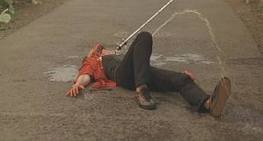
After getting busted for stealing, Mitsuko befriends a garrulous businessman named Mr. Murata, who owns a cheerier tropical fish store across town and recruits the girl to join his staff of other attractive teens from troubled backgrounds. The Shamotos can’t seem to get a word in with the lively Murata and his bombshell bride, so by the end of the week, Mrs. Shamoto is having rough sex with her new friend, Mitsuko is cleaning fish tanks with a new kind of Japanese Stepfordism, and Mr. Shamoto is helping his new benefactor cover up his 58th murder by burning bones in a bonfire and covering up to the yazuka.

Indeed, making friends is an odd aspect of adult life.
Shion Sono is easily one of the most fascinating filmmakers working today. Everything from his premises--killer hair extensions! suicide cults inspired by bubblegum pop music!--to execution feels incredibly unique but generally, not forcefully so. Sure, Sono is adamantly avante garde, but rarely does his weird feel weird for the sake of weird.

Cold Fish seems most related to 2005’s Noriko’s Diner Table, the prequel to his better known Suicide Club. Both films are not easily categorized as horror, even if they feature extreme bouts of physical violence. Thematically, Cold Fish and Noriko’s Dinner Table are even more familiar. Both explore family dynamics with an emphasis on alienated teenage girls and their inefficient, inconsequential and clueless fathers. In both cases, a far more charismatic third party steps in to lead the daughters away like a modern Pied Piper.

Truth be told, I’ve only watched Noriko’s Dinner Table once (at the now defunct Two Boots Theater, sad face) and while I remember it being densely layered, I also remember it being a tad boring. Granted, its predecessor involved quite a few treats to keep you watching, from child cults to Goblin King impersonators breaking out into musical numbers. It’s a tough act to follow.

Cold Fish, on the flip side, finds an excellent pace. Though there’s a chilly distance between the audience and characters--primarily because Mr. Shamoto is intentionally barely a man--we care enough to jump on board almost immediately. And considering where the story takes us, that matters.
High Points
From Mitsuru Fukikoshi’s restraint as the near-dead Shamoto to Denden’s all-out crazy train Mr. Murata, the performances of Cold Fish are pretty pitch perfect

Low Point
Until a good hour into the film, everything we see is filtered through the Shamotos. Hence, once Mr. Murata’s driver comes to watch Murata’s wife and business colleague get it on, it’s a tad strange from a perspective point of view
Lessons Learned
Business is just entertainment (or a ploy)
The style of Japanese passion involves a lot of cupping of the boob

Getting stabbed in the neck with a pen kind of hurts
Stray Observatoin
This film may very well feature the most incompetent police officers since The Human Centipede. I say ‘since’ because even a bottle of seltzer makes a better cop than the Germans in Tom Six’s film
Rent/Bury/Buy
Part gangster film, part serial killer tale, and quite American Beauty, Cold Fish is typical Sono in being unlike anything else. It doesn’t ever go down the route you’re expecting it, making it something truly special for modern cinema. Eventually, it also gets incredibly brutal and quite disgusting, but for all the severed torso canoodles and bone sawings, Cold Fish doesn’t lose sight of the story it tells. Sure, it splatters a lot of blood over it, but at its heart, this is a film about a detached modern family letting itself be disbanded...and getting really bloody while doing so.


Wednesday, September 21, 2011

Gimme a Head With Hair (Extensions)


Ah, Sion Sono. Something tells me that your parents weren’t the peanut-butter-and-jelly-on-white-bread kind of folks, that your afterschool activities didn’t include soccer practice and that your family pet wasn’t a golden retriever.
No good sir, I think not. I think you were born of midichlorians, that your sustenance is silicone packets mixed with Crystal Lite, that you created a life-size replica of Guernica out of lunch meat in the 8th grade and that your best childhood friend was a half leprechaun, half unicorn that only emerged at full moons and taco day.

The point is, you’re an odd duck. An avant guarde duck who seems to refuse to allow any notion of normalcy to come near your camera. Suicide Club managed to unite ear scrapings, The Goblin King, and tween pop music. Its followup/prequel Noriko’s Dinner Table focused on people who got paid to act like people in your family. And Strange Circus spent a good part of its running time trapped inside a cello case.
Is it any wonder that Sion Sono is responsible for a movie about killer hair extensions?
Quick Plot: A trio of night watchmen at a storage facility discover one compartment busting with stinky and thick hair extensions. Oh, also, the corpse of a mysteriously slain female with (not surprisingly) Pantene caliber locks. At the morgue, the clearly not quite right Yamazaki is so impressed with her mane that he brings the whole package home.

Meanwhile, a cheerier than a cheerleader on crack hair stylist student named Yuko (Battle Royale’s marathon champ turned Kill Bill assassin Chiaki Kuriyama) bicycles her way to work, a place she might as well call heaven. Yuko, you see, reallllllllly loves the art of haircutting. Think back to how enthusiastic the killer of Chain Letter must have been about chains, because that’s about as excitable as scissors and the blue stuff make the bright-eyed Yuko.


But you know what she doesn’t love? Her deadbeat big sister, an awful awful woman who constantly dumps her bruised little daughter in Yuko’s apartment. It’s ultimately not a major problem, since Yuko slowly bonds with Mami (and yes, hearing every character yell “Mami!” at a 7-year-old is confusing and weird) though their connection and shared fabulous locks eventually draws the attention of Yamazaki.

Dressed in rainbow spotted overall shorts and jazz hand gloves, Yamazaki has only been growing weirder since, well, dragging a corpse home and settling her comfortably in a hammock. For whatever reason, her hair has still been growing...and growing...and growing out of her head, eyes, mouth, and open wounds. Naturally one capitalizes on such a feat of nature by selling extensions to the local salon, which just so happens to be the place of employment of Yuko.
If the next thing you expect to happen in such a film is that the women who wear the non-vegetarian extensions begin sprouting hair in their own open wounds in mass amounts, then congratulations! You have successfully predicted part of the plot trajectory for a Sion Sono film. As facetious as that may sound, it’s actually surprising to finally be able to do such a thing. Based on the other three films of his that I’ve watched, Exte feels positively normal. 


Yes, there are killer hair extensions. And a character that spends his days singing to and about them. And a death scene that makes me thirsty for a milkshake made by putting Mr. Potato Head and my Tourist Trap DVD inside a blender.


+
=

Delicious.
But aside from that, it’s kind of just a slightly odder than usual J-Horror with some black humor busting out of its bun. Certainly a well-done oddy, but not quite at the level of mind-blowing weirdness as Suicide Club.


High Points
The major spotlighted kill of the film is grandly over the top, with visual echoes to Uzumaki and a wonderful mix of humor and ouch
Low Points
As quirky as Exte is, there's something not all there about the whole package. It starts on such a light and chipper note, flirts with darkness, side-steps with wacko humor,then hits the hour and forty five mark where I realize that as much as killer hair is bizarre and the actors are charming, I'm really, really quite ready for it to end.

Lessons Learned
Whenever possible, use hand symbols, since safety is first

A mother should never hit her little one
Instincts don’t solve cases
The Winning Line
“Sis, are you going to be afraid of hair from now on?”

Rent/Bury/Buy
When it comes to hair horror, alls I know of is the Stacey Keach segment in John Carpenter’s Body Bags and now, Exte. Already on that front, you have a recommendation.

And hey, while not perfect nor as interesting as Sono’s more serious work, Exte is sufficiently odd enough to warrant a rental. The DVD is bare bones, as is way too sadly and too often the case. Because really, if there’s one conversation I’d like to hear, it’s Sion Sono explaining what inspired him to make a movie about killer hair.

Thursday, January 20, 2011

Sing Us a Song, You're the Karaoke Man

A personal tale:
I love the art of karaoke. Few activities are possibly better done drunk than grabbing a microphone in front of your friends and emoting your musical guts out as a computer generated rainbow and blank-faced extras project on a screen behind you. Having lived in South Korea for a year, I can easily say it’s one of the things I miss the most. 
Hence, upon discovering a film called “Karaoke Terror,” my expectations shot up higher than John Goodman’s cholesterol level. When I read the following synopsis, I almost had a heart attack:
“In this dark, cult comedy set to retro karaoke hits, a war for revenge rages between two sects of karaoke devotees when a middle-age divorcée from the Midoris crew is killed by a teenage slacker from the Gakis gang. A generation gap between them, the two groups of malcontents, who share a passion for singing oldies tunes, turn their societal angst against each other in a no-holds-barred battle that leaves only death and destruction in its wake.”
Greatness should surely follow, no?
Quick Plot: The Gaki gang of early twentysomething young men get together twice a month to perform elaborate karaoke numbers, bowler hats in place and equipment installed with careful precision. It’s innocent fun, except that one member has the negative nancys to stalk a female middle aged karaoke enthusiast, slicing her neck when she rebuffs his rather cruel advances. 

Lesson One of hunting karaoke fans: they have friends.
The murder victim turns out to be one Midori of six, a tight band of middle-aged divorcees who bond over their name, unhappy place in life, and the joy they get from singing classic songs under neon lighting. Over a funeral dinner, the ladies decide to seek out Midori’s killer and get her vengeance, an act that turns out to be surprisingly simple...until the Gaki troop responds with some bloody payback of their own.

Thus a karaoke gang war commences, which I regret to inform you, is nowhere near as fun as it sounds. 
It’s not that Karoake Terror isn’t funny or smart. The film, based on a novel by famed writer Ryu Murakami, is essentially a satire that focuses on the plight of middle-aged women. In concept, that’s fascinating. But for one hour and fifty two minutes? Pretty darn dull. Comparing it to something like Suicide Club--which similarly meanders into philosophical diatribes while contrasting it with absurd violence--shows that such an approach CAN work, but you know...it has to be interesting.
See, your film is called Karaoke Terror. That implies that a certain amount of karaoke and terror will ensue. Not enough of either happens, and while what’s in between has plenty of merit in commenting on Japanese society and the relationship between people who seemingly have nothing else in common, it also takes an hour and fifty two minutes.
High Points
A truly out of nowhere ending leaves you some food for thought, plus plenty of ‘did that really just happen?’ to smile at
This:
Low Points
Some of director Tetsuo Shinohara‘s choices, including inserting random narration and the occasional seizure-ready camera tricks, feel more annoying and/or unnecessary than important in telling the story
Lessons Learned
When you pay attention to what others say, you actually understand them
Rocket launchers are surprisingly lightweight

Nothing says empowerment better than masturbating over your clothing
Rent/Bury/Buy
Karaoke Terror is refreshing in its one-of-a-kindness, but it’s also far too long and oddly paced to be a satisfying two-hour watch. Perhaps if I’d known a little more about its philosophical quirks, I may have at least been more willing to enjoy the storyline and ideas. Instead, it just sort of dragged for me, never capturing the fun its title seems to promise. Fans of bizarre Asian cinema or Japanese culture may enjoy it, and those looking for something different won’t be disappointed....just possibly bored.

Sunday, June 20, 2010

Everybody's Doing It...


For no reason whatsoever, America’s youth (ranging in age between three and seventeen, by my accounts) have become insanely obsessed with collecting colorful bracelets vaguely shaped like random nouns. Bandz, as they’re called, are simply the latest commercial product in a long line of short-lived trends that serve to annoy teachers, rob parents, divide schoolyard friends and generally make the world a worse place.

Need further proof? Examine, if you will, today’s genre-centric list of films that capture the horror of materialism gone wild:

Gremlins

Joe Dante’s seminal Cabbage Patch Kids-inspired Christmas classic is the educational gift that keeps on giving, riffing on the dangers of irresponsible materialism with the cutest metaphor to ever squeak. As parents mowed each other down in shopping malls to deliver chubby faced baby dolls to their greedy kids, Dante captured the overly ambitious gifting craze with Gizmo, and adorable living teddy bear with a rule book even Santa couldn’t follow. Predicting--or possibly, inspiring--future toy fads like Tickle-Me-Elmo and, in an odd twist, the clearly Mogwai-based Furbies.

Child’s Play


It’s hard to be the fatherless poor kid at daycare in downtown Chicago, but even harder when mom’s idea of an appropriate birthday gift is a box of pants. Between delicious breakfast cereal and Saturday morning cartoons, it’s no wonder that young Andy Barclay becomes so fixated on obtaining a Good Guy Doll, a promised ‘friend to the end’ with a $50+ price tag. Misguidedly believing such a My Buddy knockoff will bring him peace, Andy guilts his mom into using her bonus in the back alley to purchase the toy. How to punish a child for his greed? Soul snatching, naturally.


Remember when your teachers, friends, neighbors, cousins, and kittens were shedding belly fat with the Atkins Diet? Didn’t it sound like the best idea since WOW Doritos? Then, just as you were about to declare jihad on bagels, you remembered that WOW Doritos were officially declared an agent of the devil (via your toilet). That’s the lesson you should remember watching Larry Cohen’s The Stuff, a gleeful satire that uses a delicious fat-free frozen treat to explore America’s obsession with lo-cal commercialism.

Halloween III: Season of the Witch


Perhaps the holiday’s best lesson at teaching kids to make their own costumes and avoid the temptations of everybody’s-doing-it store bought digs. What happens when your child wears the same rubber mask as 75% of the buying public? He or she turns into a rotten pumpkin. Serves you right for not thinking outside the box.

Suicide Club


Peer pressure has led to many a minor tragedy: feathered hair, bullying, Phish. But few lapses of individual judgement are quite as unfortunate as the events that occur in this 2002 surrealist genre glob, wherein offing oneself becomes way cooler than XBox, ‘N Sync, or talking to the hand. As usual, pop music is the main offender, with the sweet siren songs of girl group Dessert (or Desert) calling teens, comedians, housewives, and policemen to hurl their bodies in front of racing subway trains, chop off their appendages while slicing sandwiches, and leap to their deaths at the urging of their peers. Though the exact nature of the suicidal craze isn’t quite explained and the cure comes off as questionable, Suicide Club remains the thinking gorehound’s philosophical bible for exploring mass societal behavior with macabre humor and scraped off earlobes.

Fido


Sometiems it’s not just the kids that get hooked by ubiquitous marketing. Take Carrie Anne Moss’s June Cleaver-esque homemaker in 2006’s zombedy Fido. All this stay-at-home mom wants is to have the same merchant goods as the neighbors. In this case, that good is an undead servant to call her family’s own. Though most of the films on this list demonstrate the negative aspect of trends (and Fido’s premise basically equates to modern slavery), this quirky black comedy ironically results in the most positive outcome of all. Sometimes, true love truly does start with a price tag. 

Sunday, March 21, 2010

Uza-Makin' Me Dizzy


Last week I did something for the first time in about 18 years, an activity many fine fellows I know are required to make an annual requirement. 
I had an eye exam.
Strange setup, eh? Stare at pointy objects as they move towards your nose. Put your chin in a weird dipped bowl slightly reminiscent of a baseball player’s cup. Feel as though someone is staring into your eyes without actually looking you IN the eye. Be told that you process stress too intensely and need to change your lifestyle...of vision.

As a person whose previous experience with glasses was getting a headache from Avatar’s 3D, this was odd. Naturally, the best possible followup was to watch Higuchinsky’s 2000 surreal J-horror Uzumaki (aka Spiral). Appropriate since my eyes were already looped out. Also appropriate because with my newfound soon-to-be four-eyes nerddom, it was time to turn in a makeup assignment for Stacie Ponder’s Final Girl Film Club .

Quick Plot: In residential Nagano, sweet teenager Kirie and boyfriend Shuichi (although I prefer Netflix’s description, paramour) begin to notice their increasingly wacky neighbors. Shuichi’s father spends most of his time videotaping anything with a slight spiral shape, from snail shells to pottery bottoms and washing machine spin cycles. Classmates act out in other ways, like grooming themselves with Bridgett Bardot sized hair curled like a French Poodle on steroids or stalking crushes and committing suicide when spurned.

You know, it’s just another cutting edge trend, like Giga Pets or The Jersey Shore.
Except this one is slowly dragging an entire town into a puce-hued purgatory of eery imagery and increasingly nauseating camera angles.
Kinda like The Jersey Shore.

Uzumaki is based on an epic manga (to the non-nerds, that’s, to my understanding, a medium more respected than comic books but less esteemed than graphic novels) and was considered fairly groundbreaking for its modern surrealism. Ten years later, it’s...damn creepy.
I often find myself in trouble for not praising the work of David Lynch. While I run hot and cold with his films, I’ll easily concede that Inland Empire is a strong example of dream cinema. Which is fine and not nearly as important as its three hour running time wants it to be.
Uzumaki is a perfect nightmare, from its oddly distant non sequitur dialog to random spurts of overanxious gore. Moments of horror--like a well-directed millipede and an open earlobe--mix well with eerie weirdness, including a haunting, humorously awkward scene where a slow moving high school outcast moves like a gooey snail. The result is incredibly distorting.
Something is happening in Korouzu because something is happening in 1999, or Japan, or the world in general. Like another avant garde Japanese horror Suicide Club, Uzumaki throws a lot of smoke (literally) and mirrors at its audience while casually capturing a little real world horror. High school students want to fit in. High school students want to stand out. Small towns slowly eat up the ambitious young who are dying to escape. We want nothing more than to help out parents and are horrified and disappointed when we can’t.

And so on.
There are a lot of themes floating (or spiraling) throughout Uzumaki, whether fully intentional or not. Some viewers may find the film to be an empty exercise in visual experimentation, while others could interpret the story as human and deep. What’s great about the film is that it works either way.
High Points
Kirie doesn’t have much more depth than your average final girl, but newcomer Eriko Hatsune is a sweet presence that helps to give what could be all style some heartfelt substance

Though it wasn’t the most pleasing sight to my already strained eyes, Higuchinsky’s camerawork--from upside-down surprise entrances to slight swirls spinning nearly out of frame--more than succeeds at pitting the viewer smack in the middle of a nightmare
Low Points
Don’t, as I did, take a 20 minute break from Uzumaki to make some dinner and answer the phone. This is a film meant to be absorbed in one unsettling sitting and I do worry that my failure to do took something out of my experience.
Lessons Learned
Not all girls are charmed by jack-in-the-boxes being thrust in their faces
Good hair makes a good gymnast

The best way to divert an uncomfortable conversation is to eat some very goooooood melon
Keep all power tools away from the insane
Rent/Bury/Buy
This is definitely a film worth seeing for any genre fan, and one I’ll eventually add to my collection as its rewatchability is high. That being said, I imagine its oddness and atmosphere are fairly polarizing and could prove annoying to a lot of viewers. Try it out first and go from there.