Showing posts with label paperhouse. Show all posts

Monday, February 21, 2022

Childhood IS Terrifying


While this website might have been born out of a passion for killer doll-based horror, I think I'm finally ready to accept that thirteen years into this blogging thing, homicidal children just might have clawed their way to the top of my heart, likely by slicing some porcelain achilles heels with tiny kid-sized scalpels. Whether it was Esther the Orphan's perfect curls or the Bloody Birthday trio's wacky antics, somewhere over the last decade, I've come to crave more monster youths than possessed toys.

Granted, part of that might be due to the requirements of both subgenres: anyone can shake a plaything around and call it a villain, but coaxing an actual performance out of a young actor is generally a far more challenging feat.

Now don't worry: as is tradition, we will indeed have ONE killer doll movie during February's Shortening. But today, today is for the kids.

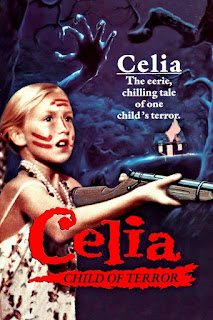
Quick Plot: In 1957 suburban Australia, Celia Carmichael (the incredible Rebecca Smart) starts her ninth birthday with a batch of life-changing events: the death of her beloved, Communist-sympathizing grandmother, the arrival of the Tanners next door, and finally, the gift of her chunky pet rabbit Murgatroyd. 


If you're thinking "none of that sounds very horror genre-related", you'd be right, so let's address the elephant in the outback first: though she may rock perfect Rhoda Penmark braids, Celia is no bad seed. Much like Paperhouse (a movie that tonally feels very close), Celia is more whimsical childhood drama than horror, lightly filled with some fantastical elements tied to our title character's favorite, incredibly disturbing fairy tale. Shudder isn't really the natural place for this to stream, but you know what? I'm not complaining.

Long out of print (seemingly like most of writer/director Ann Turner's work), Celia is a special, special little film that deeply understands and achingly translates what it means to grow up. Honestly, that IS terrifying.


Celia is a sensitive, assertive kid, much to the chagrin of her bullish dad and subservient mom. She's instantly drawn to the warmth of Alice Tanner, the matriarch of her more liberal neighbors, whose own Communist ties sit poorly with Mr. Carmichael (though Alice's pretty face certainly doesn't). Between Australia's red scare and pet rabbit persecution, all the things that seem to bring Celia joy are threatened at once. It's heartbreaking.


So Celia copes with her fantasies. There's the recurring dreams of the dreaded Hobyah, goblin-like creatures lifted from Celia's favorite schoolbook (and yes, as the great documentary Woodlands Dark & Days Bewitched suggests, The Babadook definitely took note). An abandoned, terribly unsafe rock quarry becomes a playground for Celia and the Tanner kids, occasionally invaded by her snotty cousin with dire consequences. Celia deals with such slights the way many a spirited child might: by setting ritualistic bonfires and burning effigies of her enemies with the hopes that it will translate to real-world payback.


And eventually, it does.

I won't spoil Celia, which, despite being a fairly free-wielding character study, does indeed throw us a twist in the fifth act. But yes, at a certain point, something very big happens, and I suppose it can technically nudge Celia into the genre category (particularly with the VERY final scene, that almost reads like the preface to a glorious queen bee origin story). Celia is apparently often compared to The 400 Blows in how it taps into a child's perspective, but my mind went straight to the champion of the 2020 Shortening: Poison for the Fairies. Both films understand that to be a little girl means feeling in a very big way, that the world is as scary as it is exciting, and everything that threatens what you love is a danger the bravest must face head-on. 


High Points
There's so much to love about Celia, but an area that really elevates the film is the nuance that Turner brings to Celia's parents. Yes, her father is a brutish jerk, but he does indeed love his daughter (even if, like so many fathers, he'll never understand her). 


Low Points
I'm going back and forth on the rather shocking plot twist towards the very end, and while it sits better with time, I still think it doesn't quite get the room to breathe that it probably needs


Lessons Learned
In a world before ergonomic Jansports, the baby boomer generation of Australia likely experienced early onset back problems


Animals In Peril Alert
Bad things happen to adorable bunny rabbits and kids have to deal with the outcome and I'm saying this now so you're well-prepared because IT'S TERRIBLY UPSETTING AND YOU'VE BEEN WARNED


Rent/Bury/Buy
Rabbit funerals aside, Celia is a gem of a film. It's by no means an easy watch (nor really a genre film) but it's so worth the effort when you're ready for a heavy dose of powerful childhood anxiety. 

Monday, July 6, 2020

A Dream Is a Wish Your Serial Killer Cell Neighbor Makes


For those who prefer horror discussed orally, my podcast occasionally dives into the genre and recently, my cohostess and I decided to subject ourselves to the full catalog of Masters of Horror. If you can take yourself back to the simpler times of 2005, Season 1 gathered some of the true legends of the genre: John Carpenter, Stuart Gordon, Dario Argento, Takashi Miike, William Malone--

Wait! You might have said, especially if your name is Emily. William Malone of FeardotCom? William Malone of The House On Haunted Hill? THAT a master makes?

I approached his episode, The Fair-Haired Child, with a fair amount of apathy. Watching a run of truly terrible episodes -- series creator Mick Garris's Chocolate and the incredibly problematic John Landis's Deer Woman -- my hopes were low. Imagine my extreme shock at discovering this odd little Monkey's Paw adaptation was easily one of the show's very best.


This sparked a new interest in Malone's filmography, and what better way to dive in than with the project he cared so much about that he financed the whole thing himself?

Quick Plot: A well-dressed Sean Young about to enjoy a rooftop meal receives a call, listens for a few seconds, and calmly walks herself off the ledge.


CREDITS.

Somewhere else, we meet Danny, a freshly dumped Pacer-driving art student and record store clerk. While visiting his friend in a terribly nonsecure rehab facility, Danny wanders to the psych wing where he finds a few wards of interest: Byron Volpe, a mysterious murderer whose eyes and voice have the ability to hypnotize others to do his bidding (like wife Sean Young) and Laura Baxter, a beautiful young woman suffering from a rare condition where she can only be awake for a few minutes. 


Danny is an easy mark for the charms of a sleeping beauty. When he discovers her impending transfer to a research laboratory known for its poor patient treatment, Danny springs into action, sneaking a mostly comatose Laura out to his lonely apartment.

Spending most of your life in a hospital bed doesn't do much for your social skills, and Laura proves to be quite a handful...especially when the instructions of her former cell neighbor Volpe kick in, causing her to stab a few neighbors and policemen who come too close.


Danny is soon on the run, a situation that gets even more tense when Volpe escapes. Laura, you see, had been something of a project for the powerful serial killer. Volpe could take over her dreams, turning her world into a Hellraiser 2-ish landscape of broken mirrors and Fair-Haired Child-ish goblins. Now with his chance to be with her in the real world, Volpe orchestrates a high stakes finale that involves automatons, angel wings, Jeffrey Combs playing Russian roulette, and a baby Allison Brie on the cello!


Parasomnia was a passion project for Malone, who put up his own money for financing only to have the finished project sit on a shelf for a few years. It's a shame because you know what? It's good!

There's a strong Paperhouse element to the story and details, with Malone's signature visual style making the film not quite look like what you were seeing in 2008. Much like House On Haunted Hill, Parasomnia is filled with gray clouds and almost campy color choices. Malone designed and helped build some of the film's more creative visual elements, including some steampunkish figures and a twig-haired ghost creature that haunts Laura's dreamscape. 


I enjoyed the look of Parasomnia, but more excitingly, I enjoyed the story. I had concerns about Laura's agency, but the film manages to address it in a very satisfying way. Patrick Kilpatrick makes a menacing, almost Shocker-ish villain as Volpe that feels both familiar and fresh. It manages to be ambitious in some of its ideas and visuals, but small enough to understand how to make its limited budget work. 


High Points
There's something wonderfully sweet about Parasomnia's ending. In an era where torture porn and found footage was giving us mostly cruel sendoffs, Malone's sense of empathy is refreshing, both in the fate of his main characters and how their own friends come to support them

Low Points
For as hard as the film works to make it work, there's still something inherently icky about a dude falling in love with a beautiful woman who hasn't been able to say three words to him without falling back asleep


Lessons Learned
Pretty things always have a tragic end


When introducing someone to solid foods, remember that an ice cream cone requires far more motor skills than you probably want to challenge at first bite


It's hard to have a successful musical career if you don't fly (and sometimes harder if you do, when you consider the number of musicians who died in plane crashes...)

Rent/Bury/Buy
Parasomnia showed up on Shudder just as I said to myself, "I should try more William Malone content." The timing was perfect and I'd definitely recommend you take advantage. While there are certainly elements here from other films, Parasomnia has a lot of surprises, and most importantly, is made with true care.

Monday, March 2, 2020

The Home Insurance Is the Real Horror


There's a certain kind of film that seemed to have come out from the late 198s/early 1990s, a kind of drama with heavy ideas, grand storytelling, but oddly minimalist visual elements. Michael Tolkin's The Rapture falls into that category, and now I'd add Bernard Rose's Paperhouse, a fascinatingly sparse film without a genre.

Quick Plot: Anna is an angry young lady around 12 years old. Her class clown antics and aggressive behavior at school get her in trouble, while her exasperated mother (played by a somewhat British accent warbling Glenne Headly) lovingly tries to unlock her daughter's attitude. Much of it clearly comes from, you know, being a 12-year-old girl, but the on/off parenting of her absent alcoholic dad certainly doesn't help. 


As Anna fights illness at home, she busies herself with artwork only to discover that the house she has drawn comes to life in her dreams. Hanging out both in her drawing and dream is Marc, a boy her age suffering from muscular dystrophy. Or maybe, Anna just forgot to draw his legs.


Directed by Candyman's Bernard Rose from Matthew Jacobs' adaptation of Catherine Storr's novel, Paperhouse is a strange, haunting, and hard to classify little film. While there are certainly elements of horror, it has a far more serious fairy tale vibe that should speak to both the young and mature. At the same time, you can easily understand how it would have been lost on a video rental shelf. 


In her only onscreen role, Charlotte Burke is so achingly real and bundled with feelings that seem to only make sense in a dream world. Marc, it turns out, is a real boy, the patient of Anna's doctor. How she's able to reach him via her art dreams isn't explained, nor does it ever feel like the point. 


Anna can't save Marc or rewrite (redraw?) their lives to a happily ever after ending, but there's a strange, effective power the two youths find in whatever realm their friendship exists. Anna has her family demons, which are wisely never fleshed out in full. Marc is dying, and will never experience the full life of a healthy boy. Whether their connection is mystical or purely that of Anna's imagination, there's a very genuine element in how it seems to help both grow up in their own way.


High Points
Seriously, I'm sure she had her reasons and is hopefully a well-adjusted adult human now, but what a shame that Charlotte Burke retired from acting after Paperhouse. The film rests on her young shoulders, and she brings such a wonderfully fresh energy that isn't easily repeatable


Low Points
Hey, it's not MY fault I approached this movie assuming it was a horror movie and would call to mind the only thing I like in Nightmare On Elm Street 5, but yes, I may have been slightly disappointed to not get anything akin to this:


Lessons Learned
Snogging is a lot like kissing a vacuum cleaner


When in doubt, draw a pencil AND eraser

For the love of all things in this world, don't ever film an entire film with an American actress only to tell her after the fact that she'll have to dub her dialog with a British accent while giving her no time to learn anything about the mechanics of a British accent. Glenne Headly deserved better


Rent/Bury/Buy


Long out of print, Paperhouse is now streaming on Amazon Prime, and it's well worth a watch. Know that you're getting a very spare, unusual tale of coping, empathy, and connecting that won't necessarily satisfy your usual genre urges, but this is a movie unlike many others, and that alone makes it something very special.