Showing posts with label stephen king. Show all posts

Monday, February 9, 2026

Monkey Trouble

Welcome to The Shortening! For February, we adjust the height on our camera to focus on movies featuring vertically challenged villains. If you have your own blog or podcast and plan to do the same, be sure to leave a note in the comment with your links!


Final Destination, but with a monkey-topped organ grinder in the Death role? Sign me up!

Quick Plot: Hal is having a hard time being twelve. His father Petey disappeared long ago, leaving his pessimistic mother Lois alone to raise Hal and his cruel twin brother Bill. 

Dad's career as a pilot left the family with a bundle of foreign objects and thingamajigs. While rummaging through his supply, the boys discover an organ grinder featuring a maniacally smiling monkey. They think little of it after turning its key, but later that night, their beloved babysitter dies in a freak accident at a hibachi restaurant. 


Hal quickly connects the dots. After one more round of brutal bullying, he snaps and decides to wind up his monkey again in the hopes that it will claim Bill. Unfortunately, he learns too late that the monkey's targets are out of his hands. Instead of his brother, it's his beloved mother who drops dead.


After a few more rounds of odd deaths, Hal and Bill drop the cursed object in a deep well and move on with their rather unhappy lives. 25 years down the road, Hal works a menial job and has a strained relationship with his teen son Petey, so much so that his ex-wife is starting the process of transferring parentage to her new husband (the delightful but underused Elijah Wood). 

Their plans change when Hal discovers his aunt has died in a bizarre but somewhat familiar freak accident. Bill is convinced the monkey has returned, so Hal heads back to his small Maine hometown to investigate. 

From there, a lot of people die.


In increasingly amusing ways.

I've seen most of Osgood Perkins' filmography (the exception being I Am the Pretty Thing That Lives In the House and the new Keeper) and every time, I've found myself wanting to like them so much more than I could. The Blackcoat's Daughter is beautifully filmed but narratively empty, while Gretal & Hansel never came together for me. I'm in the minority on thinking Longlegs was just dumb, and not in a campy intentional way. My working theory is that Perkins is a much better director than he is writer. 

With all that in mind, I went into The Monkey without too much hope. 


For the second time in a row, it was a joy to be proven wrong.

The Monkey is FUN. It's mean but not cruel, and tonally so clear on what kind of story it's telling and how it must be told. This is a black comedy that establishes itself from the very opening scene and constantly reminds us by having virtually every character that isn't Hal (and even to an extent, Hal) be such an inappropriate weirdo that you wonder if Nicolas Cage's Longlegs villain didn't come from this same town. 


High Points

I really do mean it when I say the tone of The Monkey is consistently bananas in the best way. It starts with a bonkers opening scene with Adam Scott, but really solidifies itself during the most inappropriate eulogy you can imagine at the film's first funeral


Low Points

Playing twins should be an actor's dream, but Theo James never really seems to seize the moment


Lessons Learned

The best way to teach your kids about death is to pair the conversation with ice cream cones


The most surefire way to bond with an adolescent boy is via the art of dance

Nothing cramps your swinger lifestyle faster than guardianship of teen twins


Rent/Bury/Buy

I was genuinely surprised by how much I enjoyed The Monkey. It knows exactly what it wants to be, and achieves it with a wildly high level of camp. Find it on Hulu when you need a nasty laugh.

Monday, March 30, 2020

If a Cell Phone Rings In the Middle of the 2010s, Does Anyone Care?


Mobile phones were still a fairly new phenomenon in 2006 when Stephen King published Cell, en epic novel about a phone call that turned users into hive minded zombies. The material was ripe for a film adaption. Hollywood being what it is, it just took so long that by the time it happened, actual filmgoers ended up looking at the trailer and wondering, "Who still answers their cell phone?"


Quick Plot: After a good dozen different production company logos, we meet Clay Riddell (King regular John Cusack), a graphic novelist waiting to board a flight to return to his estranged wife and young son in New Hampshire. When his battery dies, he hops on one of those old-fashioned machines that require cash currency to make a call right as everyone with an active cell phone receives a fast zombifying signal. 


Clay survives the chaos and quickly teams up with Tom (Samual L. Jackson) and a character named DJ Liquid who thankfully dies immediately. The pair are soon joined by teenager Alice (Orphan's own Isabelle Fuhrman). Because this is a story written by a man in the late aughts, Clay insists on braving his way through hordes of cannibals to find his young son, presumed alive even though Clay was on the phone with him during the signal.


Look, I'm not saying a parent shouldn't/wouldn't risk everything to save his or her child, even if every logical bit of sense pointed to said kid being dead or worse. It's just that so many stories, particularly in horror, use the "dad risks it all for son" in such a way that it's forced me to roll my eyes. 

Anyway, the trio travel through New England, evading the creatures, picking up a few stragglers, losing a few more along the way, and having The Stand-like dreams with a shared villain on their tails. 


As you might have guessed, there's not that much new. Not too surprisingly, the script (written by King and Adam Alleca) stays fairly close to the novel save for a rather random, not very well explained or satisfying finale. Director Tod Williams (Paranormal Activity 2) has a far better cast than this type of movie would usually warrant, but the actors are all essentially stuck playing the kind of Stephen King types that have been reused and recycled so much that they barely register. 


That's not to say Cell is as big a failure as its "sat on the shelf for two years before getting dumped on streaming platforms" reputation might suggest. Williams does manage to capture that effective 28 Days -- or more fittingly, 28 Weeks-- Later tension level when it comes to some of his chase scenes. When you watch a movie like this during the COVID-19 crisis, there's certainly some unnerving effects in seeing a world made empty and gray. While movies like The Girl With All the Gifts have since done a better job of playing with the hive mind aspect of this kind of monster, Cell makes some mildly interesting plays at the idea. 


Overall, what more can you say for a film that embodies the review of "okay?"

High Points
We've seen plenty of variations of the "sudden mass hysteric zombie outbreak" on film, and while Cell's isn't necessary the best, it's an extremely well-done scene and strong opening for an otherwise fairly middle-of-the-road-filled-with-cellphone-zombies film


Low Points
Hell hath no fury quite like cheaply rendered CGI fire

Lessons Learned
Before blasting it across a large field filled with extremely flammable beings, take a minute to consider the basic rules of gasoline 


The human brain is just one big ol' hard drive

Pacifists are extremely quick to learn good aim


Ferland's Revenge?
So I have a complicated, rather useless theory Jodelle Ferland spent most of her teenage years cursing the name Isabelle Furhman. Both made their horror mark by playing evil brunette child types, but Furhman got the far better movie while Ferland's Case 39 had a delayed release with no real fanfare or success, while her smaller part in the better received Cabin In the Woods also sat on a shelf for two years. Furhman got a juicy role in The Hunger Games while Ferland ended up in a Twilight sequel. So while I don't play fantasy sports and I usually ignore celebrity feuds, there's a petty, specific part of me itching to know whether Furhman's participation in the, you guessed it, two-years delayed, released to little fanfare Cell was part of some pact Ferland made with the devil.


Look, it's been a really weird time. Allow me my diversions where I can get them. 

Rent/Bury/Buy
Eh, Cell probably isn't as bad as you've heard, but that's not necessarily a positive recommend. If you're a zombie or Stephen King completist, this is somewhere in the middle range of what you've come to expect. It's streaming on Hulu. 

Wednesday, October 4, 2017

Come Geek With Me


GUYS! I'm doing a thing. A LIVE thing, 


For those East Coasters, come to the Alamo Drafthouse in Yonkers, NY, next Friday (THE THIRTEENTH!) for Kevin Geeks Out, a bimonthly variety show of sorts for the fun-loving nerd in us all. Most specifically, the Stephen King loving nerd that resides in your inner bully, rock 'n roll star, religious zealot, psychic kid, or whatever vessel you hide under your blue overalls. 

I'll be diving deep into Mick Garris's 1994 television adaptation of The Stand, one of the most gloriously '90s and awkwardly weird pieces of modern history. Put on your best Canadian tuxedo and join the fun!


M-O-O-N, that spells I hope to see you soon. 

Sunday, October 6, 2013

October!

We’re 7 days into the most wonderful time of the year, and I’ve barely addressed the fact that, you know, WE’RE SEVEN DAYS INTO THE MOST WONDERFUL TIME OF THE YEAR.
Precisely
Here at the Doll’s House, I have nothing overly exciting planned save for the usual weekly dose of genre (or awful, but this month, strictly genre) film reviews. While some exciting pumpkin-related shenanigans could still sprout up, I figured it was far more useful to share some links to a few of my rather talented pals’ far more interesting October projects.

Hitch up your haunted hayride and let’s roll!


-Over at The Lightning Bug’s Lair, good pal Zach (and guest host for our latest Single White Female/Obsessed episode of The Feminine Critique) is don’ting away with 31 days of covering movies with titles that include horror’s favorite contraction. Zach always makes October a truly delightningbugful time of year, and I’m sure this round will be no different.


-This being October, it’s the perfect time for you savvy e-reading bookworms (or e-worms? Is that more or less gross?) to check out a few great picks. First up is R. k. Kombrinck’s short story collection, These Lonely Places. Some of you might know the author as a barrel of laughs and Burger King hatred heard on Night of the Living Podcast, but his fiction is a far more serious matter. From giant spiders to horrifically twisted old people, Kombrinck’s writing is truly creepy, filled with surprising twists and plenty of scares.

-For those of you in need of some quality nonfiction, check out Bryce Wilson’s Son of Danse Macabre. Wilson is also the keeper of the fine blog Things That Don’t Suck (and thankfully, his writing doesn’t) and Son of Danse Macabre reads like a worthy sequel and followup to Stephen King’s 1981 book. Picking up where King left off, Wilson provides superb analysis of the genre (including video games and comics) of the last 30 years. For just $2.99, it’s a journey well worth taking.


-Get Rocked. Get Shocked. Get n’ed. All these things at Worcester’s annual horror (and music, whatever that is) convention. I’ll be taking a ride up there for the weekend of the 19th, so if any of you New Englanders are dropping in, be sure to let me know so we can say hi while wondering if Jordan Ladd would be honored or embarrassed if we asked her about her villainous role in Lifetime’s Murder on the 13th Floor.


-Gear up your ears for ShowShow, one of the Internet’s oldest and still most entertaining podcasts. Every year, the crew assembles for the Spooktacular, where they release one episode a day for the month of October. It’s a hard show to describe until you hear it, but with a bizarre collection of films on this year’s docket (George Kennedy vs. An Alf puppet supercat in The Uninvited, anybody?) and what I’ve been assured is a bottomless supply of alcohol, you can guarantee yourself a good time.


-More entertainment courtesy of the podcasting world: Outside the Cinema’s annual Halloween Throwdown, aka 16 hours of random and rare horror movies streaming live online. It's a surprisingly enjoyable way to kill a Saturday, so if you've long wanted to see films like Fade To Black and Mr. Boogedy, be sure to check it out.


-Plus, plenty of blogs over yonder on my right side blogroll will be doing truly seasonal coverage, from Chuck Norris Ate My Baby’s annual Chucktoberfest to Fascination With Fear’s Guilty Pleasures and Final Girl’s own version of SHOCKtober. 


Good things everywhere. GO GET THEM!

Sunday, July 15, 2012

The Shin-n-n-ing

For a good chunk of movie audiences, Stanley Kubrick's 1980 adaptation of Stephen King's The Shining stands as one of cinema’s greatest accomplishments in terror. To its grandfather, it was (at least at the time of its release) blasphemy.


Thusly did we get Mick Garris’ extremely literal 1997 miniseries, written by King and filmed at the very hotel that inspired the tale. To experience all three tellings is a pretty fascinating exercise in the art--and sometimes, fingerpainted afterschool activity--of the adaptation.


It surprises some (okay, my cats) to learn that I haven’t read that much of Stephen King’s canon. I adore his essay work, but each of the handful of King fiction I’ve picked up continue to kill me with final act buzzkill (Salem's Lot is a pleasant buck of that trend). Lately though, I’m becoming more forgiving in my old age of literary criticism. I blew through Carrie with plenty of energy, so following it up with one of King’s most celebrated hits seemed like the best idea since buying Maximum Overdrive on DVD.


More refreshing than a soda can to the groin!
If you’re a horror fan who has never read The Shining, head to your nearest library/local bookstore/airport and give it a go. Though King himself acknowledges that some of his prose is on the messy side, the book moves like a fascinating nightmare. Wendy, Jack and Danny are all written with a firm ear towards character and their tentative hold on a fragile family unit is as devastating as the latter half is scary. Jack’s descent is inevitable, but as King astutely recognizes in his introduction to the book's reprint, Jack isn’t a one-dimensional monster anxiously awaiting his transformation. We care about these people, making every swing of the roque mallet hurt.


But let’s face it: most readers don’t travel 500 plus pages through The Shining for a family drama about the perils of alcoholism. Inside the ghostly holdings of The Overlook lurks some true terror, from an eerily macabre masked ball to the iconic Room 217. Most memorable is Jack’s, Danny’s and Dick Halloran’s meet-ups with the growling lion made of topiary. It’s truly remarkable how effective scenes of evil garden creations can be on the page...


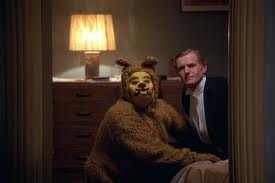
And how damn silly looking they are when brought to life by 1997 era CGI. Kubrick famously omitted the topiary from his film, claiming special effects wouldn’t do it justice. Perhaps that’s true (considering how giggly the 1980s BBC version of The Day of the Triffids made me, I’d say yes). Or maybe, like so much else in his version, Kubrick didn’t think they worked according to his vision.


Can't imagine why...


An adaptation, you see, is just that. It’s an interpretation of preexisting material, not necessarily a direct translation of it. 


One of my biggest pet peeve comments I hear from movie viewers is the whine that “they changed it from the book!”  Why is this offensive? ‘They’ (evil filmmakers with their own ideas) didn’t change YOUR book. They didn’t rape its author and force it to birth this creation or chain him or her in a tower until the writer released a Galileo-like false confession that erased any original ideas. Books and movies exist on two different plains of the universe.


Sometimes, a close-to-the-page film breeds greatness (No Country For Old Men, Atonement) while others fall flat (The Road, Blindness). What I respect most is a film that honors its source material’s essence but understands well enough that the language of film can veer wherever it wants and still be great (i.e., Children of Men or The Sweet Hereafter, fine literary works that bred incredible filmmaking).


Kubrick falls into the latter category. His Shining plays quite a bit with its source material, retaining its skill but filling it with an entirely different substance. Does it work as a film? Certainly. As an adaptation? Yes. It’s just not the translation loyal readers (and one writer) may have been waiting for. 


Jack Nicholson’s Jack is, much to the annoyance of Stephen King, not the Jack on his pages. He starts with a Joker grin and ends with the same Joker grin frozen solid, and while it’s a terrifying character that has rightfully become iconic, it’s ultimately far less complex than the tortured recovering alcoholic of the novel. It’s probably Kubrick’s biggest deviation, and one that builds an immediate distance between the audience and characters. Sure, Shelley Duvall (say nothing negative; woman has a lifetime get out of jail free card for creating Faerie Tale Theatre) as Wendy comes off as a bit of a nag, but that doesn’t mean we ever really understand Jack wanting to plant an axe into her back.


It’s understandable that the casting would irk King, particularly since the author used the character as something of a metaphor for his own struggles with alcohol. For that reason alone, it's clear why the author would take such a strong position (executive producer and screenwriter) on the second stab at adapting his material. The problem, of course, is that he put it in the hands of someone who loved the novel even more than he did.


I have a lot of respect for Mick Garris. The man clearly adores the genre and would sell his kidneys and children to make horror even better.


But that doesn’t mean he’s a good director.


The Stand is a mediocre retelling of King’s epic, with lots of aspects (the ridiculousness of the sultry pill-popping Laura Sangiacomo as a virgin, the casting of Rob Lowe, and much more) that just don’t work. His Masters of Horror episode, Chocolate, has some interesting ideas with painfully awful execution. And Sleepwalkers...well...there have been worse adaptations of King pieces.


And yet, it makes perfect sense that Stephen King would watch him direct his adored text. I obviously don’t know what their working relationship was like, but I imagine conversations went as such:


MG: So Mr. King, I was thinking of cutting that scene where Halloran misses the plane to Denver. It seems a little unnecessary, don’t you think?


SK: No way. It’s important in showing how hard the dude’s trying. Also, I wrote it.


MG: Totally! Forget I ever said a thing. Um, what about the one that comes about ten minutes later, where Halloran lands and the car rental cashier kindly tells him she’ll call ahead to put chains on the vehicle? It kind of cuts into the action over the Overlook and, well, I don’t know that we need it.


SK: Did you hear me the first time?


MG: Of course! I mean, you’re right, 110% right. I guess that means I shouldn’t even ask about that scene later where Sam Raimi has a cameo playing the guy that lends him the snow mobile thing, right? I mean, the people need to see that he gets a snow mobile thing from Sam Raimi. And when Halloran arrives at The Overlook and gets out of the snow mobile thing to brush the snow off the sign that says “The Overlook” even though the audience already knows that, you know, that’s The Overlook, we need that right?


SK: Quiet kid. Just remember Uncle Stevie’s rule.


MG: If it’s on the page, it stays.


SK: Got it. Now print me out a new picture of that Kubrick dude and tape it over that dart board yonder. I got things to do.


As King and Garris discuss in the commentary tracks, the miniseries is indeed the ideal format for a dense novel’s filming. It’s not easy to tell a 500+ page story in two hours of screentime, so the extended running length makes perfect sense.


But what Garris and King don’t realize is that a book is its own thing, one that exists on its own dimension inside the readers’ heads. We bring our own aesthetic to what we read--for whatever reason, I cast Elizabeth Mitchell and Kyle Chandler as the Torrances and resurrected Scatman Crothers from the grave to revisit Halloran--and so a literal word by word adaptation will almost always fall flat. Watching a bizzarely dreadful Melvin Van Peebles discuss his travel plans does absolutely nothing for the narrative. Just because it’s in the book does not, in ANY way require it to be filmed.


Likewise, a film can use its facilities to enhance its source material, be it through music, visuals, performances, or random touches. You know, like how Crothers' Halloran decorates his Florida condo:


No reason for it exactly, but it's memorable and interesting, something that makes us wonder a little more about the character. The miniseries never dares to embellish.


There is good inside 1997’s The Shining. Rebecca DeMornay and yes, Steve Wings Weber are quite strong as a couple on the edge, and both the loving and abusive scenes together are believably powerful.


As for the rest of the miniseries...well..the last shot was neat. Of course, before that we deal with Haunted Mansion caliber ghosts and Peebles' terrible line readings, heavy-handed musical cues and laughable CGI, plus a fatal step in miscasting that makes Danny a precocious 8-year-old that doesn’t know how to read. I won’t insult child actor Courtland Meade’s performance, as it’s not awful...just not right. I may have missed the exact moment where his age was discussed (for silly reasons involving me not understanding how to read a double sided disc, I was forced to download Part 2 en espanol and channel my inner 8th grade honors student to understand the dialogue) but either Danny is WAY too well-spoken for a 6 year old (who then graduates two years early in the film’s painful flash forward coda) or an 8-year-old with a learning disability, which doesn’t fit his clearly bright and well-spoken character in the least. Either way, WHAT IS GOING ON?


Also, his hair looks stupid.


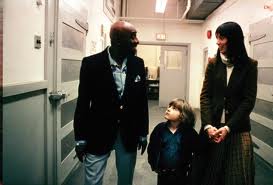
Then there’s the time period, or lack thereof. Danny talks like a child of the 90s while The Overlook uses rotary phones and Dick Halloran dresses like Willie Dynamite circa 1971. I’m confused.


Plus now I just want to rewatch Wilie Dynamite.


But enough bashing of a not necessarily terrible way to spend 4.5 hours. It made Stephen King and most likely, those who believe an adaptation should be a book-on-film satisfied. I can’t imagine it entertaining someone who didn’t read the novel, but as an example of (in my opinion) what an adaptation shouldn’t be.


Also, I spotted a goof (Part 3, flowers moving before Wings comes into frame) and I NEVER spot goofs.


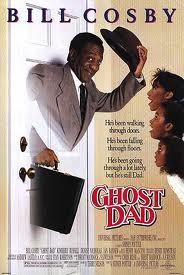
Oh, and the miniseries features a Ghost Dad coda that's way more hilarious than Ghost Dad.


Also, did I mention Danny's stupid haircut?


I don’t think Kubrick’s film is perfect, though I do cite it as a brilliant horror film and even more brilliant, if almost unrelated interpretation of a great read. I also don’t think Garris or King were wrong to revisit the material in their own manner. I just wish they remembered what film can do and actually tried to do it.