Showing posts with label sci-fi. Show all posts

Monday, April 6, 2026

The More Things Change...


One of our last few beautiful natural resources remaining on this rapidly declining planet is Turner Classic Movies, aka TCM, the cable channel that airs such a glorious grab bag of film. Whenever a genre title I haven't seen comes up on the guide, you can bet my DVR I'm going to record it. 

Quick Plot: Four very white men embark on a mission to circle Mars. The trip is uneventful until their attempted return, when they hit whatever you call the space version of turbulence and land on an earth-like planet that doesn't feel too friendly.


First comes the dog-sized paper mache spiders (ADORABLE). Then the one-eyed neanderthal-ish gang. Finally, the real horror: a cemetery with gravestones proving this is earth, but an earth a few hundred years in the future following a nuclear holocaust. 


The men are saved by the more "civilized" survivors, a prissy collection of helmet-wearing nerds and Judy Jetson-styled sexy ladies who have formed a society underground. While they're safe in the bunker, there's a clear problem: the men are so weak that reproduction rates are at an all-time low. We need testosterone, STAT!


Did someone say shirtless Rod Taylor? Because we can all certainly use some shirtless Rod Taylor.


Watching World Without End, it's hard not to imagine it framed with silhouettes of a few robots and their human friend. This is a film that SCREAMS Mystery Science Theater 3000 because it hits all of those trademarks that make for a great riff: hand-made special effects, goofy but earnest dialogue, and careful violence that feels cute. This has such a '50s sci-fi vibe that I started watching it in jeans and when it ended, I somehow was wearing a poodle skirt.


Just kidding. Who the hell wears pants in their home?

I enjoyed World Without End. The film was written and directed by Edward Bernds, a man who spent a whole lot of time on Three Stooges projects (which might explain his confusion on how violence works). It's kind of a delight. 


There's some drama and heaviness. One astronaut leaves behind a wife and kids and has to accept that they're long gone, while the very threat of nuclear war underlines the entire story. I don't love how those left on the surface are treated as wild animals, but the film makes a tiny effort towards the end to suggest a brighter future for all. So long as you don't think too hard, World Without End is a pretty fun time.


High Points
Yes, the actual monster makeup and crafting could have used some darker lighting, but this is a movie that just feels so visually fun, especially when we go underground and are treated to, well, this


Low Points
Not surprisingly, the gender balance of a 1950s sci-fi film don't really feel great some decades later


Lessons Learned
The ancients kept most of their secrets in caves

The most effective way of shooting is to put your whole body into it, pushing that gun in the same direction you're firing


Astronauts are very good at understanding the differences between optimists and pessimists

Rent/Bury/Buy
World Without End doesn't have a lot on its mind (although one can always appreciate the unfortunately never-not-relevant nuclear war warning) and that's okay. This is a charming little bite of '50s science fiction that will scratch a very particular itch. 

Monday, April 17, 2017

But Is It Gluten-Free?


Like many of my Generation MilleXial brethren, my introduction to Soylent Green came via the one and only Phil Hartman.


Sure, that '90s Saturday Night Live sketch might have spoiled the ending of one of sci-fi's most famous movies, but it still piqued my interest enough to give the film a go. It's now been a good 20+ years since I've last watched Soylent Green, and while DVR'ing off of TCM isn't that impressive a future over renting a VHS, it's still quite a thing to see with 2017 eyes. 

Quick Plot: It's the year 2022(!), and the world's population is exploding. Over 40 million people now live in the New York City area, so while I may have thought my first few Manhattan apartments, with their shared bathrooms and converted closet-space-to-bedrooms were small, I now see that I was indeed a spoiled, spoiled urbanite. 


With the world being a mess of pollution (whaaaaaaa? NEVER!) fresh food is a luxury only the 1% can afford. The rest of the proletariat "enjoys" nutritional products put out by the Soylent Corporation, supposedly plankton-based squares of protein. When one of Soylent's top executives, William Simonson, is found dead, Detective Thorn (full-toothed and scarfed Charlton Heston) suspects murder, something the deceased's business associates are quick to cover up. 


On hand to help Thorn is Sol (the great Edward G. Robinson), his elderly roommate who reminisces about a time when food came from the earth, and Shirl, the beautiful "furniture" that came with the corpse Thorn investigates. Thorn suspects Simonson's bodyguard Tab Fielding (Tourist Trap's Chuck Connors) of foul play, especially considering the working class hotshot is enjoying such luxuries as $150 bottles of strawberry jam for his girlfriend.


If you've lived in any kind of pop culture space during the last 50 years, you probably know the real twist of Soylent Green's big reveal. I suppose the biggest question one might have in deciding whether to give this film a shot is whether that matters. 


Sure, it would probably be much more rewarding to experience Soylent Green without any foreknowledge of, you know, what the titular meal replacement is made of, but in my opinion, this remains a worthwhile watch. Directed by Conan the Destroyer's Richard Fleischer, the film isn't necessarily a landmark in the genre, but like a lot of its ilk from the '70s, there's something fascinating in its somehow dated-but-ahead-of-its-time conceits of the future.  


Yes, Soylent Green, like Logan's Run or Zero Population Growth, looks like a movie about the future that came out of the 1970s. And while we may be further from 5 years away from SPOILER ALERT, packaging our elderly into cracker squares, one can't read a newspaper today without thinking, "yeah, that's not the most outlandish 2022."

The film itself is flawed, but entertaining. Fleischer's future has a great smoggy grain about it that drives home the world's ugliness, with the contrast of Simonson's luxury high-rise and its artificial charms. Heston is at his masculine muggiest, but is wonderfully softened at times by his relationship with Robinson's Sol. While I would have enjoyed more exploration of society, the film does an interesting job of establishing a bleak, but livable future, particularly in how it uses the dirty, sad mobs that seem to pile up on staircases, in churches, and on the streets.


High Points
You know that moment in Wayne's World 2 when Wayne stops at a gas station for directions, and Mike Meyers breaks the fourth wall to ask for a better actor to elevate the material (and fittingly enough, Charlton Heston wanders in to deliver the scene)? I also call this the "Peter O'Toole Saves Troy" performance, wherein an older thespian shows up in supporting role to elevate everything around him. That's how I feel about Edward G. Robinson in Soylent Green. He's just so damn good, and everything around him is better when he's onscreen


Low Points
Look, I know the big announcement of the reveal is an AFI greatest line and touchstone in pop culture, but the film's actual ending somehow feels a tad disappointing, with a sort of open-endedness that feels more unresolved than ambiguous


Lessons Learned
Old people cry a lot

Lettuce will never be exciting, even if the world hasn't had fresh food in decades


In the future, never stand too close to detectives unless you plan on being shot. The dude goes through pedestrians faster than Spinal Tap drummers

Rent/Bury/Buy
Don't avoid actually watching Soylent Green just because you know the final line. While this isn't a masterpiece of cinema, it is a hallmark of American science fiction, and it has enough truly memorable parts to make it well worth the 100 minute investment. 

Monday, June 8, 2015

Melts In Your Mouth, Not On Mars


Sometimes it’s hard to decide if a film is worth writing about here on this blog. Sometimes I’ll rent a Very Long Wait, seemingly Doll’s House-ready DVD from Netflix with my notepad ready and waiting only to realize I have nothing to say and even less to remember about it ten minutes after the credits roll. On other days, I’ll queue up an action adventure movie with no pretense of blogging only to discover that includes Tim Curry hamming up a bizarre Eastern European accent, copious lasers, gorillas drinking martinis, and pretty much everything else that someone like me treasures in cinema.


I decided long ago that horror is a subjective term on these fronts (I didn’t do a month of Animals Doing Human Stuff for nothing you know) and don’t always require that genre classification for coverage. This leads us to today’s hard-to-finger flick, 2000’s Mission to Mars. Knowing it was directed (quite oddly) by Brian De Palma gave me some inkling that I might get some mileage. Realizing it was a Disney release put that into doubt. Seeing, within 20 minutes, a character caught in a windstorm, twisted like a rung out dishcloth and de-limbed and decapitated in the process made me think, “Oh! It’s dark stuff!”


Then discovering it got a PG rating made me question almost everything.

Quick Plot: In the near future of 2020, a bunch of astronauts have a barbecue to celebrate the imminent launch of the first manned mission to mars. More importantly, Jim McConnell (Gary Sinise) is sad to NOT go to Mars because his wife, who was named Maggie, got sick and died before Jim and his wife, who was named Maggie, could go to Mars, a place Maggie, Jim’s dead wife, really wanted to go to (her space helmet would have read “Maggie”).


Note that I tell you about Jim and his wife (named Maggie) because the movie makes a point of doing so about 9 times within the first 9 minutes of its running time.

Anyway, sad Maggie-less Jim stays behind while Luke (Don Cheadle) heads up with a bunch of Russians. Just as the team discovers a trace of water, a brutal Tatooine-ish sandstorm hits, knocking out a few crew members and brutally DE-LIMBING another one.


Just your standard Act I ending for any PG-rated family flick.

After sending out a muddled transmission, Luke loses communication with earth, prompting a rescue mission manned by Jim (but not his dead wife Maggie), Woody (Tim Robbins, with the ominous “...And Tim Robbins credit), Woody’s wife Terri (Connie Nielsen), and Phil (Jerry “I’ll Always Be Vern” O’Connell). A rupture almost kills the crew, but some fast thinking by Jim (widower of Maggie) and a packet of prominently labeled Dr Pepper saves the day. Later, more mechanical trouble leads to a heavy Gravity-esque conclusion. Clearly, this ship didn’t pack enough soft drinks.


They did, thankfully, pack a whole lot of M&Ms. M&Ms are almost as important in this movie as Jim’s dead wife Maggie and her presumed favorite cola, Dr Pepper. 


I’m being rather hard on Mission To Mars and its rather odd product placement, but the fact that these items drew so much attention to themselves was simply too much not to note. One must wonder if the people at the M&Ms headquarters felt like this was their big chance to right the wrong of E.T.’s infamous Reese’s Pieces glory.


Anyway, back to the film at hand, I...have no real idea what to say. The script’s multiple writing credits is hardly surprising, since Mission To Mars jumps from tone to tone like an energetic kid who’s had too much soda and candy (well, specifically, Dr Pepper and original M&Ms). We go from earnest astronaut drama to heady sci-fi to body-ripping horror to Close Encounters whimsy. It’s rather dizzying.


Mission To Mars is not a cheap film. While some of its CGI heavy effects have aged tragically, the basic landscape of Mars looks fantastic. The cast is littered with Oscar nominated talent. The score is (maybe over-)composed by the legendary Ennio Morricone. And yet I have no idea what it adds up to.

I mentioned Close Encounters of the Third Kind earlier because that’s easily the closest companion piece I can think of. Both films have to balance the dark possibilities of the expanded universe with a more gentle perspective of embracing other life forms. Mission To Mars, unfortunately, just doesn’t feel like it earns its ending because the path to it has gone in so many directions. It’s an odd one. 


High Points
Well, there are a lot of GOOD things about this film. Great cast who can sell the occasionally terrible dialog (DID I MENTION THAT MY WIFE MAGGIE IS DEAD AND SHE WAS AN ASTRONAUT AND HER NAME WAS MAGGIE BUT SHE’S DEAD NOW?). Beautiful art direction. Believable sounding science...


Low Points
But, well, aside from not knowing who should be watching it, the film is also occasionally quite dull

Lessons Learned
In the future, young lotharios will dress like Danny Zuko

Some couples dance, but the cooler ones go to Mars


Evolution began with alligators, which turned into dinosaurs, which turned into wooly mammoths, which turned into buffalo

Nothing is impossible when you're millions of miles from earth in a giant face


Rent/Bury/Buy
I was curious to see how someone with Brian De Palma’s sensibilities would handle the bigger material of Mission To Mars. The answer is ultimately kind of blah. There are definitely sparks of intrigue in the film, but it’s ultimately more interesting to see what doesn’t work than what does. De Palma fans will enjoy spotting a few trademarks (including a long opening tracking shot) and space-centric sci-fi fans will appreciate a lot of the film’s touches, but the final product is a rather messy thing.


Friday, February 24, 2012

Let Us ALL Welcome Our Insect Overlords


What’s shorter than an ant? A flea I suppose, but fleas are dog-eating jerks without any redeeming factors (other than inspiring long ago plagues that can occasionally breed good film material). 
But let’s get back to ants, those ubiquitous, hard-working, architecture-loving, slave-holding monarchists. When I put out the call for recommendations that suited The Shortening, I got some peachy picks. Today’s entry comes courtesy of Trever over at the fine film blog Kentucky Fried Popcorn, who pointed me towards 1974’s sci-fi oddball Phase IV.
Quick Plot: Something strange is happening in the cosmos, and though experts predicted everything from climate change to earthquakes, the only real effects seem to be felt in ant colonies. Our narrator explains how those six-legged soldiers of different species have been holding international conferences to communicate, something "ordinary ants" just don't do.

This might sound dry and scientific, and while much of Phase IV is, I shouldn't go any further before explaining how we actually see this unfold. Director Saul Bass (better known as a famed graphic designer who created title sequences for Psycho, The Man With the Golden Arm, and much more) works with actual nature footage to detail the development of the ants, with extreme closeups on a rainbow of little guys sitting in a circle and nodding their antennae at one another. It's kind of adorable.
Also, pretty darn impressive. It's impossible to watch Phase IV without wondering how some of the footage was gathered and when you see the massive ant army funeral complete with perfectly placed lines of tiny corpses surrounded by their mourners, you'll see what I mean. The biggest shame of Phase IV is that the film doesn't get a single DVD extra. Considering both the plot science and behind-the-scenes mystery, it's one of the most frustrating DVD releases I've seen in recent years.

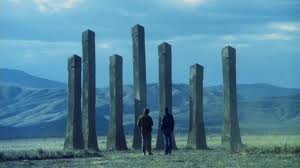
But back to The empire of the ants! (but not, you know, The Empire of the Ants). Their behavior sparks the interest of one Dr. Ernest Hubbs (Nigel Davenport), an entomologist, and his mathematician assistant James (our narrator, played by Michael Murphy). The pair head to the Arizona desert to investigate from a big scary Epcot Center-like facility while southwestern ants build 2001-ish monoliths and eventually, drive a family out of their home. 


The fleeing farmers find Hubbs' digs just as the scientists release a deadly pesticide into the air with the hopes of wiping out the approaching ants. All the humans--save for a pretty and bland young woman named Kendra--crumble to their death covered in a yellow dust. 

Oddly enough, this doesn’t upset Kendra nearly as much as seeing her horse attacked by ants. Remember that ‘this’ refers to her family dying painfully from contaminated air released by the scientists she’s now bunking with, but you know...we’re all individuals.

Except the ants, who now seem to be operating under a hive mind. James is tasked with uncracking their code of communication while Hubbs becomes dangerously obsessed with their case, refusing to leave their not-so-secure bunker even after he’s bitten in a way that swells his fist into the size of volleyball. Kendra, meanwhile, walks around looking spooked until she has a mysterious conversation with a spunky escapee.

Said fugitive ant is, well, as awesome as an ant could be. We’re talking Honey I Shrunk the Kids awesome, only in a less “I’m Going To Help Children” way and more “Let’s Eff These Humans UP!” kind of style. The little ant that could--let’s call her Cindy, just cause--has some great adventures in the lab. While the menfolk are out doing scientific things like send a painful sound pitch over the desert, Cindy watches her big sister attempt to chew through the power cord only to be thwarted by a guard praying mantis. 

Cindy, however, is a smart cookie (eater). The little lass succeeds in pulling the praying mantis onto a live wire, setting the security guardette on fire and silencing the signal. 

Isn’t that cute?
Phase IV is a strange film, and I mean that in the best of ways. Although its premise and time should put it squarely in the Nature Fights Back subgenre, it’s far headier and more ambitious than something like the goofy (but amazing) Frogs or Day of the Animals. In fact, it’s far more appropriate to put it on a double bill with the similarly smarter-than-its-peers The Incredible Shrinking Man. Both films explore the relationship of man to his world, more specifically, how that relationship is altered when one of the two finds some sort of new awareness. Phase IV is actually more subtle about this, leaving most of the philosophical conclusions up to us. It’s pretty amazing how far some advanced micro-camerawork of the natural world coupled with an ethereal score can take the audience.

High Points
Though this might turn off some viewers, the lack of human melodrama helps to keep Phase IV’s tone pointedly clinical. Trust me, this is a good thing.
Low Points
Phase IV is such a strange experiment that apparently would have been even stranger if Bass had his stamp on the final cut. Word on the Internet Super Highway has it that Bass had originally planned a surreal montage to close things out, something that might have been gnarly but tragically, the lazy DVD release is bare bones of that or ANYTHING discussing this weird little gem

Lessons Learned
People get killed sometimes


The best kinds of games are serious


Ants are amazing creatures and we should do whatever they tell us. WHATEVER THEY TELL US!!!


Inevitable ‘I Am Seven’ Realization
“What does it mean? A circle...with a dot?” our hero wonders with full earnestness. Please excuse my second grade medical diagnosis that duh, dude's got a cootie shot
Rent/Bury/Buy
Phase IV is a different kind of film, a smart sci-fi with an ambitious script (by Mayo Simon) and genuinely unique approach. Some viewers might be put off by the film’s cold style, but I found it refreshingly different. The DVD nudity makes it more a rental than a buy, but raise six glasses with tiny arms to the hopes that it might eventually get its due treatment. Like a hard-working colonist eating poison for her queen, it deserves better.

Thursday, February 9, 2012

Honey, I Got Incredibly Shrunk


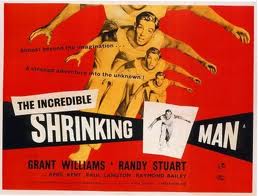
Well before a miniature Lily Tomlin played with gorillas, some time before a man became amazingly colossal and eons before two pairs of teenage neighbors pitted a lovable ant against an oddly California-based scorpion, Richard Matheson adapted his own tale of small-en-ing for Jack Arnold’s gloriously black and white suburban universe. While The Incredible Shrinking Man himself may not be a villain per say, his plight has inspired so much in cinema history that we can’t ignore his story here at the 2nd Annual Doll’s House Celebration of the Vertically Challenged any longer.

Quick Plot: Scott Carey (Grant Williams) is a successful man of the ‘50s: he has a pretty wife, a nice home, prestigious job and handsome physique worthy of all of the above. While out on his brother’s boat on a seemingly normal summer cruise, Scott spots a mysterious fog that leaves his skin misty. Some time later, Scott starts to notice significant weight loss and far more disturbing, shrinkage.


Not Seinfeldian shrinkage, or at least, not so outspokenly so. Scott measures himself a full four inches shorter than his driver’s license height and despite early doctors’ comments that such fluctuations are normal, Scott knows better. When his wife no longer needs to stand on her tiptoes to peck his cheek, Scott digs deeper to learn that the peaceful ocean trip has exposed him to a dangerous chemical solution that science can’t stop from making him tiny.

What to do when faced with such a future? Unable to drive or work, Scott sells his story only to then suffer the effects of tabloid fame. Meanwhile, his increasing littleness makes it harder and harder to connect with his wife, leading Scott into a warm friendship with a carnival midget (back when that was the correct term) before even her three foot stature becomes too high. 


Sentenced to live in a dollhouse and battle the family cat, Scott is mistaken for dead and imprisoned in the basement, where Shelobian spiders prowl and food is scarce.


The Incredible Shrinking Man is one of the 1950s’ best sci-fi films, up there in its own way with Invasion of the Body Snatchers and Them! Based on a novel by future Twilight Zone contributor Richard Matheson (who also wrote the screenplay), it’s on a much smaller scale than some of the more celebrated monster tales, but emerges quite well because of it. Scott—played with appropriate frustration by Williams--is essentially alone in his struggle and the film rightly captures that with its style. Long stretches contain no dialogue but are served well by a hard-working score, while most of the actual speaking is his own thoughtful (sometimes too much so) narration.


There’s an easy horror film or goofy comedy to be made out of Scott’s plight, and many a lesser filmmaker has tried (see Bert I. Gordon’s inferior Attack of the Puppet People or 1981’s flop The Incredible Shrinking Woman). It’s a ripe concept for any genre, making Arnold and Matheson’s approach all the more interesting.

This is a film that takes itself seriously. While such a decision can occasionally kill a film’s potential for fun (oh hai Firestarter) it works here because of its simplicity. Much has been written about the deeper themes of Scott’s condition—in losing his stature, he loses his manhood until he recovers it by stabbing a spider with his penis/pin, blah blah blah—and it’s easy to see why. In his daily shrinking, Scott loses every piece of his former identity, from a loving wife to bank account to dapper clothes. It’s his ultimate decision to embrace the future that makes The Incredible Shrinking Man something for philosophy class.


High Points
55 years later, the amplified sound of a fuzzy legged spider scurrying towards a defenseless man? Still scary


I’m not overly familiar with the career of Grant Williams, but he gives a superb performance here, believably transforming from a ‘50s superman to angry and powerless husband to desperate survivalist. Considering he’s mostly alone onscreen for the film’s latter half, it’s all the more impressive


Low Points
Look, I love me an oversized tarantula battle as much as any arachnophobe, but are we just supposed to ignore the fact that Scott’s fuzzy nemesis is…you know, a TARANTULA? Perhaps the unlikely inclusion of a scorpion in the Honey I Shrunk the Kids’ backyard isn’t so far-fetched after all…


Lessons Learned
Since The Children clearly hasn’t taught us this hard enough, never assume fog can’t hurt you


People just don’t get shorter! (unless they’re sprayed with nuclear goo)
Always leave some Twinkies or other long-term snack in an easy-to-reach spot in the basement. You just never know


Small Wonder…
As a cat owner, watching a film like The Incredible Shrinking Man takes on a whole new level of fear. Were I to shrink to levels of GI Joe, I LIKE to believe Mookie and Joplin would still recognize my smell and voice well enough to not bat me around like a yarn mouse. I’d LIKE to believe that…


Rent/Bury/Buy
Long unavailable on DVD, The Incredible Shrinking Man is now on a disc with another decent (if less noteworthy) sci-fi flick The Monolith Monsters. This is a film that would have benefited more from a Criterion-ish DVD treatment, but it remains worthy of a cheap buy or rental even with nary an extra in sight. Sci-fi or ‘50s fans will find plenty to savor, and those who enjoy smarter than they seem genre films can’t go wrong with checking it out. Plus, tarantulas!