Showing posts with label hammer. Show all posts

Monday, August 1, 2022

Little Orphan Mary


Has there ever been a film duo more perfect than Christopher Lee and Peter Cushing? 


You don't have to answer. We know. 


Quick Plot: A trio of older, incredibly wealthy Brits are murdered in careful manners that leave their cause open to accident or suicide. Meanwhile, a school bus filled with sinfully noisy Scottish orphans is derailed, perhaps by a justifiably grumper driver, perhaps as a continuation of the conspiracy, or maybe because one of the injured is Mary Harb, the daughter of an infamous murderess. 


Mary is recovering under the care of Dr. Peter Haynes, a caring psychiatrist who senses his young patient is in grave danger. Lucky for everyone, his supervisor Mark is played by Peter Cushing so naturally, Mark's best pal is a semi-retired but very competent Col. Bigham and obviously, he's gloriously inhabited by the towering perfection that is the late Christopher Lee.


Bingham knows that so many related untimely deaths are no mere coincidence. As he continues his investigation, Dr. Haynes strikes up a gratifying (in multiple ways) relationship with Joan Foster, a journalist working to explore the story of Mary's birth mother, Anna Harb. 


A glorious angry redhead ex-con, Anna wants her child back and might be willing to murder a few other orphans and doctors to do so. Or maybe these charitable millionaires have some homicidal plans of their own. It's a mystery!


A delightful one, to be sure. Based on John Blackburn's novel and directed by Countess Dracula (and more excitingly, I Don't Want to Be Born!)'s Peter Sasdy, Nothing But the Night is a crafty little thriller filled with dynamic characters and sharp twists. Even the score makes for a jaunty watch, playfully toying with children's tunes one moment then smoothing out a sexy saxophone to amp the romance in the next. 


I won't spoil the weird, wonderful ending, but it must have been a shock in 1973. It may have even given a certain celebrated comedian-turned-great-horror-filmmaker a few good ideas. With that and the Cushing/Lee blessing, I'm fairly shocked that Nothing But the Night doesn't seem to have the fanbase it deserves. 


Maybe it's the contemporary setting, or that this isn't an official Hammer studio production, or that the horror seems to lean more into mystery novel than supernatural for most of its run. Whatever the reason, it ends today: Nothing But the Night is a surprising little joy. Go get it. 


High Points

Perhaps it's that Brian Hayles' screenplay has a whole novel to pull from, but it's incredibly refreshing to see how almost all of the adult characters are so clearly drawn and fully fleshed out in a story-heavy 90-minute film. Granted, all Christopher Lee really needs to do is show up and the audience is enthralled by his very presence, but his Bingham is somehow immediately recognizable, while Georgia Brown's Joan and Keith Barron's Peter create fully dynamic professionals whose brief chemistry helps to make a quick subplot pop


Low Points

How is it possible to throw in a reference of a famous triple murder but never actually explain the details? And yes, really, I'm just formally requesting a prequel about the glorious Anna Harb


Lessons Learned

A prostate gland treatment is hardly the end of the world


12 is a perfectly adequate amount of men


"Scattergun" and "knocking pen" are very common American terms (that I've personally never heard in my apparently not-so-American life)


Rent/Bury/Buy

At the time I watched Nothing But the Night, it was on but leaving Amazon Prime. I would imagine it's since moved to another streaming site, so do some Googling and grab it. You won't be disappointed. 

Monday, December 16, 2019

There's a Snake In My Hair


Thanks to a little movie called Clash of the Titans, my childhood included a rather odd obsession with the story of Perseus and Medusa. Considering just how great that myth is, it's almost strange to realize just how few films play around with the stony possibilities of gorgons.


Quick Plot: A young artist named Bruno is painting his muse only to discover she's pregnant with his child. Eager to prove himself worthy in her father's eyes, he flees to ask for her hand in marriage. Unfortunately, before he can hear the word "no," his girlfriend is mysteriously turned to stone. The next day, Bruno is also found dead, his corpse hanging from a tree. 


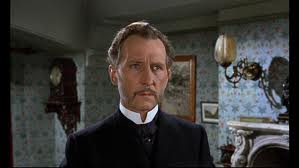
The easiest course of action for the town to take is to posthumously convict Bruno of murder/suicide, something verified by Dr. Namaroff (Peter Cushing!) but unacceptable to Bruno's family. After his father gets stoned during his private investigation, his brother Paul shows up to finish the job. He finds a sympathetic ear in Carla, Namaroff's assistant, who has a mysterious movie condition of slight amnesia that couldn't possible be connected to anything relevant to the main plot. 


The Gorgon is a Hammer production, which thankfully means Christopher Lee is legally required to show up. When Paul declares "I can't tell you how glad I am to see you!" upon the arrival of Lord Summerisle, we in the audience have to wonder just how meta such a line is. 


Directed by Hammer veteran Terence Fisher, The Gorgon falls somewhere on the high end of low in the Hammer canon. The more subtle stoning horrors are played to good effect, but the lack of a memorable lead (our main character isn't determined until two of his relations die) hurts, not to mention the incredibly disappointing finale with its paper mache level special effects. 


High Points
I'll never complain about a torch-bearing angry town mob

Low Points
One doesn't exactly expect to find transgressive feminist themes in fifty year old British horror, but it's still a shame to see Carla be presented as such an object of a character. While she begins as having her own agency, that quickly goes away once there are enough men on hand to dedicate the rest of the film to saving her. 


Lessons Learned
In the early 1900s, your average upperclassman was an incredibly adept fencer


No-good bohemians make terrible decisions in the middle of the night

The proper pronunciation should be GORgon, not gorGON (note: this comment is aimed squarely at TCM host Ben Mankiewicz, who pronounces it the latter even though NOBODY in the movie does)


Rent/Bury/Buy
The Gorgon isn't a Hammer must-see, but anything that unites Christopher Lee with Peter Cushing has its merits. 


Wednesday, February 8, 2012

That's Alotta Monkeys!


I wasn’t expecting The Woman In Black to qualify for The Shortening, but here I go out to the theaters on Friday night like any old civilian and what do I get?

Creepy kids


Antique dolls


5’6 leading men


Monkeys shaking maracas


Insert press tag on hat and venture forth!

Quick Plot: A silent prologue follows three precious Victorian girls having a tea party with an assortment of horrifically wrong-looking dolls. Oh, and that’s not even the freaky part. Without a word, the triplets arise to leap out the window.


Credits!

Flashing forward to the movie’s later Victorian present, the widowed lawyer Arthur Kips (Radcliffe) is heading on a business trip from his young son. WIth his career in jeopardy, Arhur heads to a far-off marshy town where all the locals spout ominous warnings about the abandoned home Kips will have to enter.


It’s not easy. Arthur’s late clients lived in a mansion across the village with the route dependent upon the marshy tide. Years earlier, their young son drowned in a tragic carriage accident. Ever since, the town has seen a rash of mysterious child deaths--suicides, perhaps--and the legend of the titular Lady In White--


Damnit. You know what I meant.

Kips does his best to sift through mounds of paperwork amid the eerie house noises, but once the nursery’s menagerie of music boxes, clowns with cymbals, and monkeys--so many, many monkeys--gets partying, it’s hard to ignore the whole “this house is haunted by dead children and the really pissed off woman that killed them” thing.


On hand to help is Julius Caesar himself, Ciaran Hinds as Daily, a wealthy local mourning the death of his own long-lost son. Skeptical of superstitions, Daily cares for his crazy-with-grief wife who sometimes channels the lost spirit of their child.


Between medium sessions, fog-covered cemeteries, and Changeling-ish wheelchairs, The Woman In Black is an enthusiastically hard-working film. Director James Watkins embraces the Hammer mystique full-force, never winking at the audience or downplaying the fairly horrific dead child weight that hangs on so many key scenes. It’s an important choice because unlike so many other ghost stories that seem so pent on righting the original wrong, The Woman In Black isn’t necessarily satisfied by sympathy.


One local girl drinks poison while another burns to death in a fire. Like an Elm Street without telephones for tongues to stick out of, this is not the place to be if you’re under 18.


And that’s easily one of the most effective tricks of the very effective Woman In Black. Arthur is sympathetic enough as a sad widower trying to hold it together for his son, but it’s more the idea that this unlucky town’s youth is constantly at risk whenever a stranger dares to stir its eternal ghost that really makes the film something sorta dangerous.

High Points
Amid dead little girls and suicidal mad women, it’s nice to find some surprisingly witty moments of humor lurking inside The Woman In Black. The jokes never detract from the scares but help to keep us amused by the characters for whose souls we’re already fearing

SPOILER ALERT!

I absolutely adored the ending of The Woman In Black. On one hand, it didn’t wimp out with a happy Hollywood sing-off. At the same time, it wasn’t mean in scope. Yes, Arthur and his cherubic lil artist of a son do die—in what we imagine is a pretty gruesome manner—but they do so together, sparing either any further loss. It’s kind of bittersweet

THUS ENDETH SPOILERS 

Low Points
Ahhh, the plight of modern genre cinema sound design and its increasing predicatbility. There are a good dozen or so jump scares staged with perfect visual punch, but just about every one is heralded with ham-fisted music that kills its effectiveness


Old Habits
Although a few grays too young for the role, Daniel Radcliffe acquits himself quite well to his first major non-Harry Potter performance. It’s my fault entirely that I found myself constantly wondering how he could sort through all those documents without the aid of his wizard glasses


Lessons Learned
If dispatched to a haunted house on a job that will either make or destroy your career, quit dilly dallying with ghost hunting and get to the paperwork already


Postal workers are and have always been lazy jerks

When in doubt, cut to a monkey doll


If you're name is Daniel Radcliffe, don't ever take a train. Seriously kid, it's just irresponsible at this point


See/Skip/Sneak In
I liked The Woman In Black far more than I expected I would. That being said, this isn’t a revolutionary genre film—if anything, it’s decidedly Hammer and old-fashioned—and will probably be just as enjoyable at home with the lights off, where you don’t have to worry about cell phone jingles or popcorn crunching. I’d love to see the film do well in theaters if only to support this kind of moviemaking, but it opened to better-than-expected numbers so if you want to save your Alexander Hamilton for half the DVD in a few months, I won’t come back and tell your children to off themselves. That’s just tacky.

Sunday, September 11, 2011

Sometimes They Come Back...Wrong


I imagine few tragedies in life can ever come close to losing one’s child. It’s devastation on the most primal level of humanity, and a concept that has, not surprisingly, yielded some of cinema’s most touching, tragic, and haunting films to date.
The premise of Wake Wood, one of the newly restored Hammer Studios' releases, seems poised for inevitable sadness. Stop me if I’m wrong.
Quick Plot: Grieving parents Patrick (The Wire and Blackout’s Aiden Gillen) and Louise (The Children’s Eva Birthistle) move to the quaint rural town of Wake Wood after the their daughter Alice is mauled by a German Shepherd. When a citizen is accidentally killed by a lamb (go with it), town mayor Arthur (a refreshingly understated Timothy Spall) offers the couple something very special, a gift only Wake Wood can give.


There’s magic in the town see, dark, scary, but incredibly cathartic magic open to a select few. Arthur can resurrect Alice for a period of three days, after which she’ll again be gone forever and Patrick and Louise must then remain in town for the rest of their lives. This being a horror film, we know that a) Patrick and Louise will take the offer and b) something...won’t...turn...out...right.


At this point, you’re probably having intense flashbacks to Fred Gwynne’s ankle slicing in Pet Sematary. Wake Wood is indeed in that canon of sad parent horror, and has a similar feel. Once Alice is back, the film toys with sweet happiness before slowwwwwwwwly revealing something amiss. 


I’m delving into mild spoiler territory here. While I won’t give away the ending, I do want to discuss a very specific turn Wake Wood takes at the halfway point. If you plan on seeing the film--and I do recommend a rental--then you may want to exit at this point. I won’t be hurt.
Much.
Once we learn that Alice didn’t come back as planned, Wake Wood becomes, more ore less, another darned kids horror flick. Now as anyone familiar with my adoration for Bloody Birthday and Who Can Kill a Child? knows, I do enjoy that subgenre with the same enthusiasm I generally have for nachos or mint chocolate chip ice cream. With that in mind, shouldn’t the sight of a yellow slicker wearing seven year old punching people through the stomach have made me squeal in joy?


Well sure, if that’s all I thought the film needed. But Wake Wood sets itself up as something so much deeper. When you have a whole town chasing a little girl with torches, it’s something of a disappointment.

High Points
The opening five or so minutes do an excellent job of establishing Louise and Patrick's tragedy and subsequent move with the perfect level of show and tell


I’m not normally prone to jump scares, but there were at least two such moments in Wake Wood that did indeed make me gasp, certainly a sign of effectively developed tension
Low Points
The idea of an entire town having experienced these kinds of resurrections is quite haunting, and when we get those glimpses, incredibly powerful. Though Wake Wood is essentially the story of Patrick and Louise, it feels like there could have been a little more exploring of how such an ability would affect--both positively and negatively--a whole community
SPOILER ALERT

The final beat of Wake Wood has a menacingly mean black humor ring. I actually found it horrid. The film has brought us to a sad, but finished place, one where Louise is happy in the afterlife with Alice as she waits for a new child to be born in death. For our last shot to be a threatening layout of C-section items and a straight-at-the-camera wink from Patrick feels shocking for the sake of shocking and ultimately, a punch in the pregnant belly of characters we’ve come to truly care for.
THUS ENDETH SPOILERS


Lessons Learned
Always dress your child in bright colors, particularly if you’re going to be chasing her around in the dark woods for the bulk of your story and a shimmery yellow raincoat improves visibility tenfold


Stray Observation
In the three things I’ve thus far see actor Aiden Gillen in, the man always seems to get explicit sex scenes. Just pointing that out.


Rent/Bury/Buy
Wake Wood is a chilling film, one with a fantastically sad premise and some extreme tension. Personally, I was let down because it just feels as though the material was denser than what it produced, but it still manages to be a worthy rental. The DVD includes a batch of deleted scenes and nothing else, a disappointment as this film screams for more discussion from its creators. 

Wednesday, February 23, 2011

SupercalifragilisticexpialiDavis


Bette Davis has an open invitation here at the Doll’s House, so it should surprise no one that her 1965 maybe-killer-kid outing, The Nanny, would take its place during the Month of the Vertically Challenged Villains. Without further adieu, I give you the grand dame of cinema (who isn’t Joan Crawford).
Quick Plot: A wealthy British family has been torn apart by the accidental (or cue dramatic sound cue, WAS IT?) bathtub drowning of its youngest member. Ten-year-old big brother Joey was sent to an institution of sorts for two years after he went on a hunger strike/massive jerk attack on his nanny following the tragedy. He returns home with the same bratty attitude while sickly mom sighs and stuffy dad leaves town for a business trip.
You know what that means. It’s up to supernanny Bette Davis to bring a spoonful of sugar into the house, but that’s quite a challenge when the spoiled juvenile delinquent wants nothing more than to make her life hell.

The Nanny is a Hammer production, but you won’t find any naked vampiric breasts or crimson blood in its black and white frames. The story unwinds slowly, inviting its audience into this unhappy WASP family and giving us plenty of time to wonder where the truth lies. Joey is a horrid little boy, but we also know enough about Bette Davis to expect a director to milk her craziness and give us the goods. But Nanny is soooo calming and surely can’t be evil. Or maybe--

I won’t spoil The Nanny, an underseen but strong little thriller that keeps you guessing and cursing at children for most of its 90 minute running time. The film doesn't break any molds, but it's a high quality hidden gem that if nothing else, lets you wonder how much better the world could have been had Bette Davis been cast as Mary Poppins.
High Points
Bette Davis is, as expected, quite magnificent, but much also must be said for child actor William Dix who toes a fine line between sadistic brattiness and sympathetic misunderstood little boy

I always appreciate smart casting and Jill Bennett and Wendy Craig are absolutely believable as flaky rich sisters, both in visual likeness and performance
Low Points
Yes it’s only 90 minutes, but there does come a point when The Nanny starts to drag, something perhaps inevitable (for me) when it comes to the mystery genre
Lessons Learned
Most grownups are balmy
Expensive juvenile facilities might put on a good show, but that doesn’t mean they’ll cure your son of silly hijinks like staging a fake suicide for laughs
Small children shouldn’t have pillows

Rent/Bury/Buy
The Nanny isn’t the most exciting film I’ve watched this month (c’mon: we kicked it off with Bloody Birthday!) but it’s a classy piece of genre fare that should keep Davis fans satisfied. I only learned of its existence from Fangoria’s recent 300th anniversary issue a superb piece with hundreds--literally, three of them--of movie recommendations. The Nanny is slow and not as macabre or campy as some of its era’s colleagues, but pop it on the queue for one of those slower, wine-infused days where the classy can meet the horror.