skip to main |
skip to sidebar
First, the bad news:
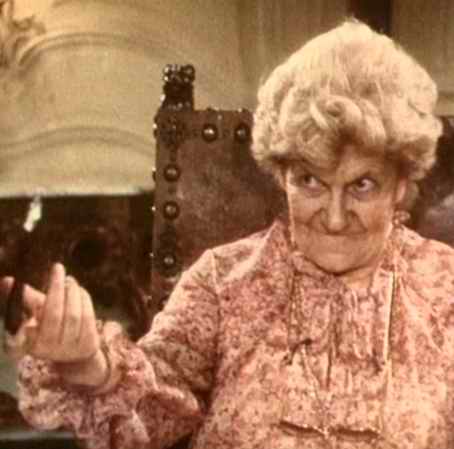
There are no grandmothers to be found in Rabid Grannies. Nor is there rabies. Our two sweet nonagenarians do become monstercized, but as demons more akin to Anjelica Huston’s Grand High Witch and far removed from poor Old Yeller. Also, they’re aunts.
Now the good: Rabid Grannies is fun, plain and simple. Not a classic and 99% not frightening, but this Troma distributed Belgium horror does provide 90 minutes of gooey kills and occasionally clever jokes, all at the expense of a humorously unlikable extended family that the world could do well without.
Quick Plot: In a picturesque European village, two sweet and wealthy old ladies--one resembling a softer Elaine Stritch and the other a poor man’s Betty White--and their Chaucer-esque house staff prepare for their dual birthday party. Meanwhile, a vast collection of money grubbing nieces and nephews make their ways to the secluded mansion for the annual inheritance baiting kiss-up competition. We slog through a funny but definitely overlong 40 minute introduction to the nastiness of these would-be heirs, including a horny playboy, a fat dildo maker, a WMDs dealer with possible blood ties to Timothy Dalton, the world’s worst lesbian, a squirmy priest, and a few more characters in need of a good demon eating. The real horror would be meeting the family black sheep (because how much worse could it get?), but instead, the unseen disinherited Satanist sends a mysterious smoking box to his not-so-beloved aunties.

Finally, after one performance of Greensleeves and plenty of pointed squabbling, our senior citizenettes are transformed into man-hungry monsters with Deadite senses of humor. After a few quick kills, our characters find themselves separated into mixed groups, all the better to show their true, mostly cowardly colors. A few heroes/heroines emerge, but more importantly, the oilier folks die painful yet creative deaths, sometimes involving post-mortem blinking.
High Points
The initial transformation and first kill are, agreeable to the little boy’s assertion, “smashing!”
The fate of Belgium’s least loved priest comes in a funny yet surprisingly disturbing scene with a rewarding payoff
You just can’t go wrong when you toss a child’s limbs down a staircase
Low Points
The ridiculously simple seduction of the heroic lesbian by the smarmiest of sleazebags is just plain offensive
Lessons Learned
Having your hand chopped off is no big deal, since it will be immediately bandaged in an impossibly fast cut
Never inhale a gift from someone that hates you
Opera singers sober up quickly when pursued by elderly demons
WMDs have come a long way since 1988
Rent/Bury/Buy
I have a special nostalgia for Rabid Grannies, as I can recall the gleeful rental during my judge-a-film-by-its-title days of yore (okay, first, those days are far from over as witnessed by my queuing of The Sinful Dwarf and second, this phase is dangerous as witness to my less than stellar Gourmet Zombie Chef From Hell experience). Does it hold up? Yes, in that it’s just as much fun as I remember. Although this was distributed, and not produced by Troma, all the standards are there, including gratuitous nudity, colorful gore, and hit-or-miss jokes. Rabid Grannies won’t change your life, but it will give you something to smile about. The DVD is packed with extras (or so I hear, since I used the Netflix Watch Now service) so a well-priced release could easily warm your shelf with senior citizen scariness.
Not Stritch:
Stritch:
Firstly, a big thank you to the fantastic Final Girl for sending out the Film Club invite to cover The Beyond. I know I’m not alone in considering her blog the best in the otherworldly realm that is horror cyberspace. Stop by her site at http://finalgirl.blogspot.com/ and check out the other Film Club goers reviewing Fulci’s messy masterpiece this week.
If Lucio Fulci were alive today, I imagine his favorite store would be Target. Like the films of the late Italian director, most of these ubiquitous shopping centers are filled with bright-but-not-quite primary colors and incredible value on just about everything you could ever want. The only thing missing for the late Godfather of Gore is the synthesized music, so aggressively present in much of his films but oddly absent from the pseudo classiness of corporate style.
The Beyond is Fulci’s glorious attempt to please just about every possible horror fan with a particular fetish by including oozingly grotesque scenes of every sort. Terrified of tarantulas? Here’s an extended cut of a fuzzy arachnid feast. Zany for zombies? See last twenty minutes. Scenes of acid dissolving human bodies? They’re on sale. Eye gougings? Take three. Children’s heads being blown apart? Do you have to ask? Incredibly enough, the only standard missing from this 1981 goretastic classic is nudity.
Quick Plot: A down-on-her-luck New Yorker named Liza inherits an abandoned hotel in Louisiana. Aside from the leaking pipes and flooded basement, the gothic mansion has a minor location problem in being built over one of the seven gateways to hell (and here I thought the American portal was a drive away in New Jersey). Despite the warnings of a blind Purgatorian refugee and the odd quadruple coincidence of four house employees dying in freak accidents, Liza continues her renovation because giving up would mean going on relief. We all have our pride, but personally, I’ll take bankruptcy and food stamps over the possibility of having my face eaten off by precariously placed sulfuric acid or hungry spiders that chew more noisily than false teeth crunching on high fiber cereal.

Heavily influenced by the Theatre of Cruelty pioneered by Antonin Artaud, Fulci’s The Beyond remains a uniquely icky, occasionally frightening, sometimes laughable but inherently lovable piece of surreal wackiness. Once you accept the unrealism of the film’s setting and stop applying human logic to the characters’ actions, the ride is kind of a blast. Yes, it’s silly that a clearly intelligent doctor with great aim would not realize that shooting a zombie in the head is the only way to kill it after blasting his way through a horde, but you know what? If he figured that out, there would be less zombies. That would make me sad. Would most rational humans start scanning the classifieds after watching every one of their co-workers die a disgustingly painful and improbable death? Probably, but the majority of us are also not dubbed actors basking in baths of latex and fluffy liquid foam. Give in or get out.
If I have one major complaint about the film, it’s the obnoxiously prevalent scoring of electro-instrumental music that Fulci uses to overstate nearly every moment of tension. This is a stylistic choice of the time and one that can be seen in his other works, but it’s hard to find true fear in any scene when it feels like the filmmaker is simply pressing the play button. It's telling that the one scene with a true jump scare (to avoid spoilers, I’ll just call it puppy love) has no music. While I still admire Fulci’s work, I can’t help but wonder how the film would feel with a different soundtrack.
High Points
The sepia-hued opening sets a nice stock footage/old-time movie-esque mood
Many scenes, such as Emily’s first appearance on a lonely road, have a quiet and understated beauty that helps to make later visions of hell so much more terrifying
I love how Joe the Plumber is almost exclusively referred to as “Joe the Plumber.” It helps that his speaking voice sounds vaguely like Elvis Presley
Low Points
Because I can never resist an opening-scene-of-Point Break reference: Why is Joe the Plumber’s resurrected corpse wearing what appears to be an oversized Richard Nixon mask?
I’m pretty much just surrendering any plot holes to the acknowledgement that The Beyond is not meant to make sense, but allow me one random pick...let’s see, I’m closing my eyes, picking out of hat...okay, how was the Little Red-Headed Girl filling her time following the death of her parents/possession of her body for several days in the natural world? Eh, I’ll move on since the payoff is so rewarding.
Lessons Learned
Hell’s guarddog tarantulas could use some oil in their joints
Carte blanche has a different definition in Italian-translated-English
If there’s one thing that defines New Yorkers, it’s not being afraid of ghosts
Satan has an awesome sense of humor; note how the blueprints for hell were written in disappearing/reappearing ink
Winning Line
“This man needs to get to a hospital.”
Whew, thank goodness the doctor arrived to tell us that the house painter who had just fallen three stories, landed square on his back, and is now bleeding profusely needs professional care.
Rent/Bury/Buy
Appropriately enough, The Beyond spent a good deal of time in movie purgatory before being rescued and restored by the likes of Quentin Tarentino and Anchor Bay. I own the 2000 release which offers a nice selection of extras, including a warm and casual commentary by stars Catriona MacColl and David Warbeck. The most recent repackaging adds a few new interviews, but as long as you have the unedited 89 minute cut, any DVD should have enough content to keep you grossed out and content. Whatever you may think of Lucio Fulci and his oeuvre, the man knew how to put on a show. Unabashedly repulsive, colorful, gooey and ridiculous, this is one of a kind to rewatch whenever your life is feeling too darn normal.
“I’m not going to tell you about this.
I refuse to.
There are things you know you’ll die before telling, things you know you should have died before ever having seen.
I watched and saw.”
Jack Ketchum is a dark guy. Of course, coming from a horror blog that's a highly sincere compliment.
The Girl Next Door is a 1989 novel that slowly crept its way into the public conscious, eventually becoming an author-baptized film in 2007. One part Stand By Me and some parts The Incredible Torture Show, both book and film take one of those ripped-from-the-headlines horrors that even Dick Wolf's Law and Order staff wouldn't touch with a ten foot gavel.
In 1965 Indiana, a teenager named Sylvia Likens was sent to live with a single mother named Gertrude Baniszewski. Three months later, Baniszewski was convicted of first-degree murder while her children and several young neighbors were revealed to have tortured, beaten, and mutilated Likens under her encouraging watch.
Ketchum’s novel does not try to recreate the Likens tragedy (for a fairly accurate portrayal, see the Showtime original film An American Crime, starring the always fine Catherine Keener and a pre-Juno, reversed role Hard Candy Ellen Page). Instead, he takes the essence of this crime--adult sanctioned evil and how easily it can spread in anytown, USA--and moves it to the falsely idyllic 1950s suburbia.
Our narrator is David, a man who begins in the present day by telling us that real pain is something most people have never experienced. He's not kidding.
As a boy, David plays with the usual assortment of neighborhood kids, often under the lax supervision of Ruth Chandler, an embittered divorcee raising three alpha males. David's 13th summer begins with the arrival of Ruth's orphaned nieces Susan and Meg, the latter being beautiful, independent, two years older, and the obvious target of a street-wide crush and puppy love. In the real world, she could grow into the prom queen. In a V.C. Andrews' novel, Meg would overcome a series of gothic dramas to become a strong-willed heroine little girls could idolize. In The Girl Next Door, Meg has no such luck.

Ketchum's construction of Ruth is fascinating, if sketchy. As the girls slowly ease into their new family, Ruth begins to grow cruel towards the elder Meg, openly chiding her for her weight and burgeoning sexuality. What starts as a few minor punishments quickly escalates into full-blown torture, with Meg becoming a basement prisoner to be beaten, scarred, and raped under Ruth's supervision, David's confused observation, and our horror.
The Girl Next Door is as disturbing as you've heard, and depending on your stomach, more so than you can imagine. It's also incredibly absorbing and a fascinating delve into the terrible possibilities of child urges. The kids in Ketchum's world are cruel and sadistic, but like J.M. Barrie said, all kids are born heartless. Common assumption is that the adults--particularly mothers--will help children to tame their wildness and train their sympathies. What happens, asks Ketchum in his afterward, if an adult relinquishes that power? Worse, what happens (or, sadly enough, DID happen), when that figure of power gives into his or her own sick fantasies?

Meg is a vehicle for sexual and violent frustration, from Ruth's weird hatred of femininity to the boys' dangerously ranging hormones unleashed. Ketchum's real power comes from David's voice: like the film, he is mostly an observer, a powerless pre-teen who knows that what's happening is wrong, but is too scared, confused, and, for a time, fascinated to take any kind of physical or moral stand against it. David is, as Ruth says, "a nice boy and all," but he’s also a 13 year-old boy. The most disturbing passages of The Girl Next Door--of which there are many--come from the quick asides and observations of our flawed hero; here and there, David lets himself fantasize. He’s not a villain, but Ketchum’s willingness to smudge our hero’s intentions takes the novel to a much more complicated and scary place.
I highly recommend this book to anyone looking for a dark, challenging, and skin crawling read. Ignore the original paperback cover, with a skeletal cheerleader straight off the poster for Return to Horror High. While I think the film did a decent job of capturing the dirty creepiness of the novel, Ketchum's original is a much more disturbing trip into believable hell.
See what I mean?
Many films are broken by poor narration--woe be to Diary of the Dead, which can function as a good movie if you ignore the monotone rambling of an incredibly unlikable character--but every once in a while, the right voiceover can open a story to new depths. Dexter would lose a lot of dry wit without Michael C. Hall's briilliantly honest musings, and Fight Club's rabid punch would be much softer were Edward Norton not such a linguistically gifted insominiac. Nobody likes hearing dull speakers recapping their autobiographies; the same goes for a bland performer underscoring the events of a film plot.
Since film is primarily a visual medium, narration must also be justified by the needs of a story. The studio cut of Blade Runner is such an abomination because Decker never seems to be the kind of man to articulate his feelings, much less ramble on about them for an unseen audience to share. On the other hand, The Prestige plays with a diary reading, Cockney speaking Christian Bale as he ties Hugh Jackman's magician in knots and advances the plot along the way.
Thankfully Baxter, a 1989 French thriller (of sorts) utilitzes one of the most refreshing and necessary narrators of recent film history: a sociopathic, philosophically minded, and positively adorable bull terrier that may or may not have been the European answer to the all American, Bud-Lite swilling Spuds McKenzie.
Quick Plot: With the Camus-esque voice of Maxime Leroux, Baxter tells us how he has always been fascinated by human beings. Soon he is plucked from a dog shelter and placed with an elderly, not overly canine-friendly woman who can't decide what to think about her underwear-sniffing companion. Baxter, however, is fairly sure how he feels: he loathes his new madam for her bland lifestyle (best represented by her sterile odor) and wastes little time finding a replacement family in the young, amorous couple next door. It's a dog's life until the arrival of a weak, disgusting creature commonly referred to as the baby. Luckily for Baxter, a young boy in desperate need of a best friend lives nearby. The typical game of fetch and obstacle course adventure follow cheerfully and it seems that our purebred has finally found his soulmate...except, of course, said soulmate happens to be a budding Hitler afficionado already constructing a neighborhood replica of the Fuhrer's suicide bunker.
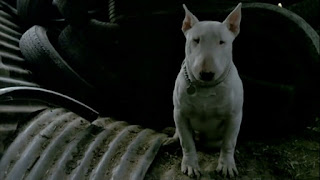
I've met dogs like Baxter--usually, they're shiba inus, chows, or some other beatuiful but aloof breed--and, as someone who spent a few years working in the dog industry can say, I wouldn't put it past some canines to spout off Sartre or muse about the importance of discipline during their generous spare time. While I truly believe that most dogs want nothing more than a scratch on the belly and a bowl of kibble, there are certainly exceptions. Observe a police dog interacting with his master and you'll notice little affection but serious respect. There are indeed animals that prefer the latter. Personally, I'll keep my lick-happy lab mix, but damned if I'm not thoroughly fascinated and impressed by the complexities of the Baxters in the world.
High Points
The choice of a bull terrier as the lead is perfect: as dogs go, they have the capacity to do serious damage, but those petite bodies and oversized football heads (they always remind me of the Canadian South Park residents) add such a unique cuteness to their overall impression that it's easy to sympathize immediately with our antihero
Young Francois Driancourt's performance as Charles is thoroughly unsettling
Baxter's self-loathing during a sex scene (no doggie style jokes, please) is just plain hysterical
Low Points
Some of the human drama, including a typical teenage rebellion, fall a little flat when all we really want is to hear Baxter's observations
Lessons Learned
Telling a girl she looks like Eva Braun will get you some L-O-V-I-N', at least in 1980s France
Pavlov knew his shit
For a typical French teenager, the death of four puppies is far more tragic and unforgivable than the death of 6 million Jews
The Itching Flea Question
I had some hesitations about watching this movie as I fall into that ridiculously unbalanced demographic of people who can stomach monsters ripping open human stomachs but get teary eyed and offended at the slightest suggestion of animal violence. There is a small amount of dog attackage in Baxter, but thankfully, the editing makes it fairly clear that no bull terriers were harmed badly while filming. In terms of the story, the dog is portrayed as such an animorphosized character that you don't really look at him the same way as say, Will Smith's dream shepherd in I Am Legend. The best example of this comes during Baxter's Baby Plan: as you watch, consider where your sympathies lie and if and how they change.
Rent/Bury/Buy
Sadly this DVD is rather empty, with no special features explaining how many pups played Baxter or what happened to disturbingly good child actor Driancourt. Still, it's a wonderfully weird and unsettling film that's unlike anything I've ever seen. You probably won't recognize anybody involved with the production, but Baxter--a favorite of camp king John Waters--is certainly something to remember.
The Signal is a minor gem of a film, a tri-directed 2007 horror/comedy/thriller that hints at greatness, revels in dark humor, and ultimately slides into a romantic snooze. Frightening, funny, and frustratingly uneven, this is a fine--if flawed-- foray into low budget independent cinema by the mighty (and low profile) triumvirate of David Bruckner, Dan Bush, and Jacob Gentry. No, I don't know much about them--including who directed which segment--but they're definitely on my radar for future films.
Quick Plot: After a night romp with a mixed tape-making lover, unhappily married Maya (Anessa Ramsey) returns home to discover her bearish husband (AJ Bowen, channeling the Pam-spurned Roy from The Office) wielding a baseball bat at his sports buddies while the big screen TV ominously plays a psychedelic glow of rainbow sherbet. Anyone who’s read Stephen King’s Cell can guess that technology is a little angry with us (or maybe just bored) and is looking to arouse a good ol’ round of mass insanity and violence in its human consumers.
Evil machinery is nothing new, but The Signal’s freshness lies in its construction: the film is told in three parts, with three directors using three distinct styles to follow a handful of characters through a night and day in a small city gone mad. The approach is similar to another recent indie horror, The Zombie Diaries, with both benefiting from using standard monster setups that enter new and darker directions.
Part I is raging horror, as Maya attempts to escape the city of Terminus with the help of a possibly crazy, possibly just well-equipped with survival skills Sahr Ngaujah. The intensity recalls the opening of Dawn of the Dead 04, as the spread of violent chaos spreads through the hallways of a modern apartment complex and into an empty street at dawn. The fear is real, the action is unpredictable, and we're caught in an intensely believable and terrifying world on the edge.

The second segment abruptly switches moods to capture the blackest of comedy, as Maya’s weirdly cheerful neighbors prepare for a sunny and balloon-filled New Year’s party, unaware that their guests may be delayed (or dismembered or dead). The performances are very deliberate and a tad one dimensional (although Scott Poythress does make a refreshingly unconventional leading man) but once you accept the new direction, the laughs are as hearty as they are bloody. There is still plenty of horror to be found--Bowen's exterminator by way of Abu Ghraib is a sight I won't forget anytime soon--but the comedy is perfectly pitched in a very dark hue.

It may be a matter of personal taste, but I got lost in the third segment, which moves the perspective to Maya’s boyfriend (Justin Welborn, who probably spends an average of eight minutes a day convincing people on the street that he's not Simon Pegg) as he makes his heroic way to the city’s edge. The contrast in tone from the offbeat macabre silliness of the previous segment to the quiet drama of this part feels too jarring and dull. Although we do care for this unlucky couple, the flashbacks, musical cues, and general heaviness of their conclusion feels much longer than its thirty minute run time .
High Points
A conversation with a smoking head-in-a-vice is as wonderful as it sounds
Something that always scares me about raging human horror is the manual factor; being shot is probably painful, but being killed by hand tools seems far worse
Call me nerdy, but Lewis and Clark jokes never fail to succeed
Chad McKnight's performance as a lazily oversexed and generally unwanted (even if the world didn't have The Crazy) guest is, for a brief time, the ahem, life of the party
Low Points
Clark's frantic-yet-somehow-exposition-rich explanation of what the signal may be drags down the center
The montageness of Part III never feels earned
Lessons Learned
When everyone in your neighborhood has turned into a raging homicidal maniac, it’s probably unwise to walk around with head phone at full blast
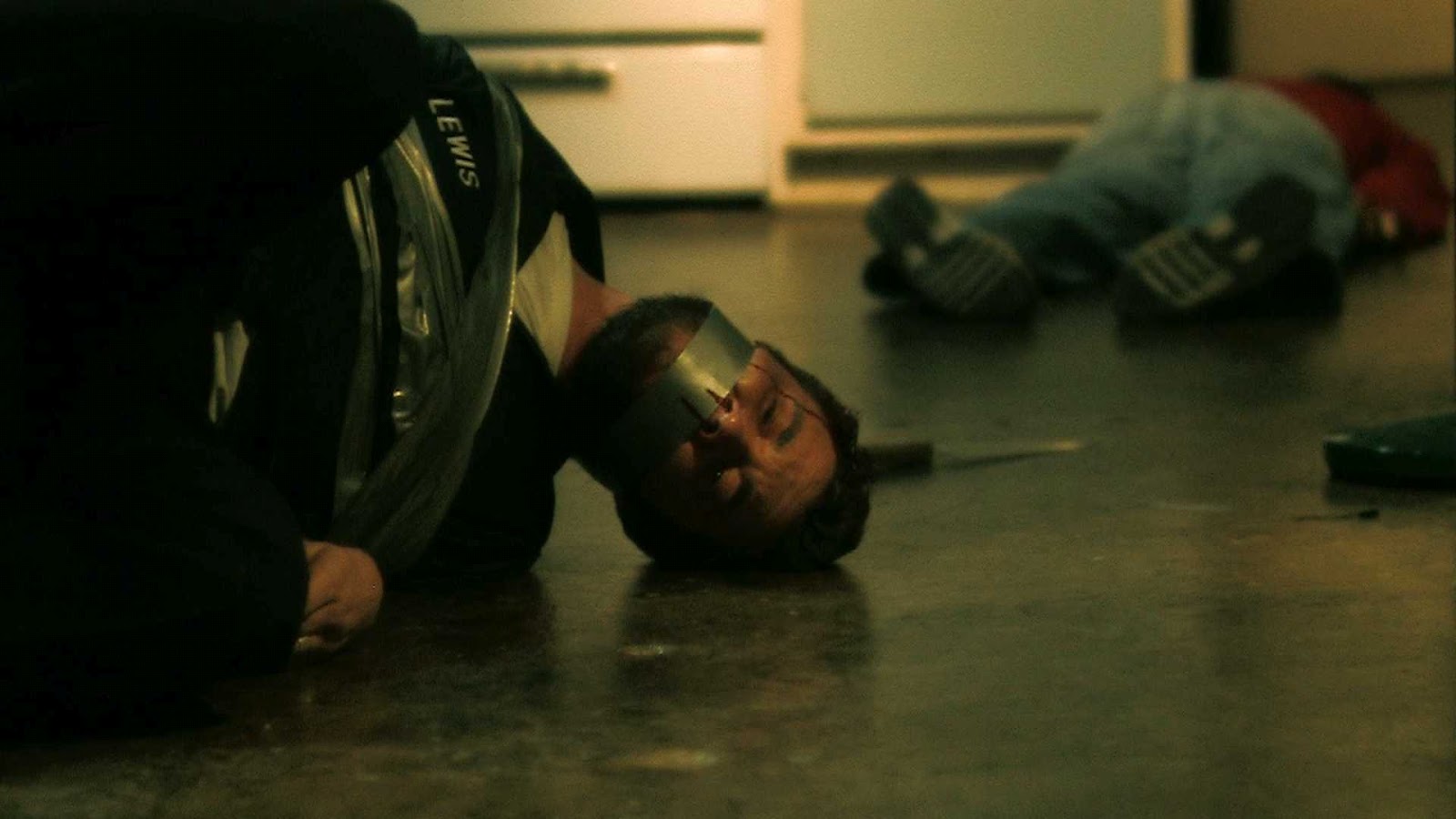
Despite previous evidence to the contrary, duct tape does not solve every problem
Always wear your seatbelt
Rent/Bury/Buy
This modest sleeper was well discussed through 2008, even garnering an Independent Spirit Award nomination. It's a highly imperfect film, but certainly worth a viewing, if only to form your own opinion on what worked and didn't. There's a part of me that wished the entire film had been done in the brutal style of the first third and another part that wanted a full-length comedy with all the violent cruelty of the second segment. Ultimately, the triple action made this a unique experiment that has its low points, but succeeds at creating atypical scares and laughs. The DVD comes with a commentary and several extras, so it's an investment worth making if you enjoy violent horror and/or black and bloody comedy with a modern twist.
Doomsday cults present a terrifying possibility for genuine horror, yet there seems to be a shortage of quality entries about the subject when it comes to modern cinema. I suppose self-appointed messiahs don't bring in the Friday night crowd and sometimes, real-life tragedies make fictionalized depictions feel tasteless and exploitive. Generally, films featuring cults (a mighty Google challenge, as one must, in doing research, first sift through some very temptingly distracting cult movies) tend to focus on devout Satan fan clubs, like the co-op board from hell in Rosemary's Baby or the children-hating corporate folks of Halloween III. In the mainstream, Children of the Corn and its bevy of underrated sequels come the closest to fully exploring (and exploiting) the idea of blind faith on a mass scale.
For these reasons and a few more, the description of Daniel Myrick's Believers was fairly promising. A small but creepy collection of educated professionals and their children have been making minor news as they prepare for the mathematically predicted apocalypse. Meanwhile, two all-American paramdedics (one so strapping, his sunnily pregnant wife is giving him a son!) are called to a lonely restop to revive a dying woman as her little daughter watches. Before you can say David Koresh, a truck of white-clad gun toters shows up to haul the do-gooders to an underground bunker, where doomsday plans are in full swing (although for all the fiery rain and simultaneous suicide talk, the ascension seems easier to plan than a baby shower).
Myrick is best-known as half the team behind a little something you may have heard of called The Blair Witch Project. That film, for all its prosperity and influence, never quite pushed its innovative filmmakers into the commercially successful sphere of cinema. Myrick has some decent straight-to-DVD horror credits that help to soften the blows of The Blair Witch 2, but he hasn't come close to backing his juggernaut with further proof of directoral ability. Unfortunately, Believers doesn't help.
In every possible way, this is a mediocre film, confused from the very beginning as to what type of story it wants to tell. The setup has plenty of potential: a mathematic cult that has discovered the formula to the universe is philosphoically promising. It's just not developed. At all. Was the concept too heady and sci-fi? Why not emphasize the human drama by exploring the characters of the cult members to suggest how these people came to put so much faith in a Tobin Bell-voiced Teacher who's good with numbers? Let us feel something as they near their end. Doesn't happen. Another option: make a suspenseful thriller. Problem with that is you need atmosphere, but Myrick seems to lack the creative energy necessary to produce it.
Sigh. All of these ideas are tagged and dimissed in Believers. It's clear that the filmmakers had ambitious intentions in theory, but failed to find any interesting ways to get them across. I'm guessing the film began as an intelligent, numbers-based horror in the vein of Pi, but the approach was deemed unsellable and susequently dumbed it down. Or possibly the reverse: the film maybe was intended to be a simple cult story and someone threw in bogus science for a twist. But as my recent fortune cookie says, "If you chase two rabbits, both will escape." I'm pretty sure that somehow explains this film.
High Points
There is an attempt to show how a seemingly regular joe could come to believe in a cult's teachings, but the execution--a long exposition-soaked monologue that explains the character's religious background--feels clunky and obvious
About 20 minutes from the end, I declared that a sorely needed, if predictable twist ending would be the only way to mildly redeem the 90 minutes that had come before it. That did happen
Turning a restroom into the Reflection Room makes perfect sense
Low Points
A lead heavy soundtrack doesn't mesh with the unmoody lighting choices
Is there a rule that says every cult has to wear white and speak in monotone?
Lessons Learned
Super genius cults that have the intelligence to decode the universe and revive the dead still have the age old villainous problems with peacefully killing the one tied up guy with the ability to foil their plans
Super genius cults haven't evolved past chalkboards
Telling a shifty mechanic you don't trust him when you're all alone is probably not a good idea; turning your back while exploring his weapon-ridden shop is even worse
Winning Line
“I can’t believe believe you don’t know you’ve been fucking brainwashed!”
I can. Because, you know....that's what brainwashing is.
Rent/Bury/Buy
I wish I could recommend a rental, but honestly, the best I can give Believers is a casual viewing on cable. I will say that the DVD includes a director commentary and several deleted scenes, so those as weirdly fascinated by cults as I am may find something redeeming there. Ultimately, this is just an exercise in the cliches of cult culture. Nice touches--such as the bathroom graffiti reading "Mathematics is the language in which the gods speak to each other"--are wasted when all the film has to show for it are bland and faceless zealots with glossy eyes.
Few things make me happier than discovering a 21st century horror film made well (okay, watching a 1980 cannibalistic martial arts extravaganza is more exciting, but still). The Ruins, a 2008 adaptation of Scott B Smith’s novel, is a wonderful surprise. Dubbed The Killer Plant Movie by the not-so-many that saw it, The Ruins can be classified on the upper tier of the sub-sub genre of postcard pretty tourist horror, sparked by the uneven Hostel and continued with the empty glossiness of films like Turistas.
Quick Plot: Four young Americans (initially appearing to be escapees from an American Eagle catalogue shoot) befriend a strapping German named Mathais (Joe Anderson, the hammer-wielding Max from Across the Universe) while vacationing in Mexico. After a rowdy and raunchy night of drinking, the quintet--accompanied by a token Greek whose very quietness spells expendability--decide to take an excursion to Mayan ruins where Mathias’ brother has been exploring on an archeological dig.
It’s not too long before Very Bad Things begin to happen, not the least of which includes being surrounded by gun-and-arrow-toting, Quechuan-speaking locals. A surprising and grisly first kill drives the cast up an Apocalypto-esque temple while the no nonsense Mayans build a shanty town to keep the young folks terrified and trapped.

As the poster art shows, there is indeed vicious vinery to be found upon that hill, including bratty little flowers that are all too happy to mock you when you’re down. What makes The Ruins such a powerful film, however, is that the greenery is only the starting seed of the terror. Sure, it sets up our young and beautiful cast for a few genuine supernatural (or maybe superorganic) scares, but the real horror comes from watching these friends and lovers caught in a hellish and inescapable situation. Yes, a literal thorn in your side sucks, but it’s the murderous locals, limited water supply, poor cell phone service, and growing suspicions amongst friends that truly rustle the sheltered lives of our vacationers.
High Points
Despite the overprettiness of the cast, the roles are not nearly as stereotypical as one would expect from this kind of a film; even though she’s blonde and briefly naked, Laura Ramsey’s Stacy is not a token slutty bombshell. Likewise, even though she’s brunette and fully clothed, Jena Malone’s Amy is far from the spunky and sweet heroine we’d expect her to be
It’s always refreshing to see sunny days filled with horrors
Low Points
Maybe it’s intentional, but the obnoxious Americanness of the beginning feels like well-worn territory
A few moments of plant attacks (particularly involving a lazily animated corpse) remind us why the special effects are not the highlights
Lessons Learned
Evil flowers are not your friends, but they can be powerful weapons*
Common sense dictates not to wear flip flops on a nature hike
Always include a med student when planning a couples’ getaway
When someone is holding a knife, it's not very wise to approach him/her from behind
Rent/Bury/Buy
The DVD is fairly extra heavy and includes a director commentary (often my make/break to purchase feature), so if you catch a well-priced copy, I say buy. The Ruins is definitely worth a watch. I don’t want to overpraise it by calling it a classic; it’s not. But for people that like to see modern horror made well, this is a refreshing example. Despite a seemingly standard setup, the story doesn’t go where you expect it to. And for those that imagine a killer plant movie sounds less appealing than a middle school production of Little Shop of Horrors, let me reassure you that even the most macabre of drama teachers wouldn’t come close to staging the amputation scene you get here.
*MILD SPOILER: While I think the characters generally made some fairly intelligent plans, they did completely miss the one opportunity they had for escape: throwing the plants at their Mayan captors. If nothing else, doing so may have created a chaotic firing party amongst the Mayans, thus giving the kids some time to make a break for the jeep. Perhaps I’m just a tad spoiled from having recently watched the wonderful Rutger Hauer-headed Flesh + Blood, where the catapulting of plague-ridden dog meat figures into a brilliant climax.








 Posts
Posts